In this article
- What is the difference between a commission deal and a flat fee?
- How do you calculate what a commission deal is worth?
- What is the break-even point between commission and a flat fee?
- When should you take a flat fee?
- When does commission make more sense?
- What does a fair hybrid deal look like?
- What terms should you check in a commission deal?
- How do you counter a commission-only offer?
- How do you track whether a commission deal paid off?
- Frequently asked questions
Take a flat fee when the brand is buying your work, and take commission when the brand is buying sales you are confident you can drive. When you can't tell which it is, ask for both: a base fee plus a commission. That hybrid is where most fair deals end up.
Commission-only offers are common. In impact.com's 2025 creator survey, commission-only was the most common way creators were paid, at 35%, while only 19% received flat fees even though 26% said they would prefer them. Brands like commission because they only pay for results. That is fine when the results are likely, and a bad deal when they are not.
This guide gives you a simple way to put a dollar value on any commission offer, the break-even point against a fee, the hybrid structures to propose, and the contract terms that decide whether a commission is worth anything at all.
Key takeaways
- A commission is worth roughly: clicks × conversion rate × average order value × commission rate. Run that number before you say yes.
- Work out break-even sales: the flat fee divided by what you earn per sale. If you can't confidently hit it, take the fee.
- Production work, usage rights and exclusivity should always be paid upfront, never on commission alone.
- Hybrid deals (base fee plus commission, or tiered bonuses) share the risk and are increasingly common.
- The fine print matters as much as the rate: attribution window, returns, payout timing and how long the link keeps paying.
What is the difference between a commission deal and a flat fee?
A flat fee pays a fixed amount for agreed deliverables, such as one TikTok and two Stories, posted by a set date. You are paid for creating and publishing, and the brand carries the risk that it doesn't sell.
A commission deal pays a percentage of each sale made through your link or code. You carry the risk. If the post underperforms, you have done the work for little or nothing. If it takes off, you earn more than any fee would have paid.
A hybrid combines the two: a smaller guaranteed fee plus a commission, or a fee plus bonuses at sales milestones. For the wider comparison of the two income streams, including disclosure and content control, see affiliate links vs sponsored content. This guide is about pricing a specific offer.
Lumanu's payment data shows the direction of travel: performance-based deals grew 35%, and 68% of contracts now include performance metrics. Brands want to tie spend to results. Your job is to make sure the risk is shared, not handed to you.
How do you calculate what a commission deal is worth?
You don't need perfect data. You need a reasonable estimate built from your own numbers.
Expected commission = expected clicks × conversion rate × average order value × commission rate
- Expected clicks. Look at past posts with a link. How many taps did a similar post send? Your link in bio analytics or the program dashboard will tell you.
- Conversion rate. Of those clicks, what share bought? If you have affiliate history, use it. If not, ask the brand what similar creators convert at.
- Average order value. What does a typical basket cost? Ask the brand. Bundles and upsells raise it.
- Commission rate. The percentage in the offer, applied to the amount the program actually commissions (often excluding tax, shipping and discounts).
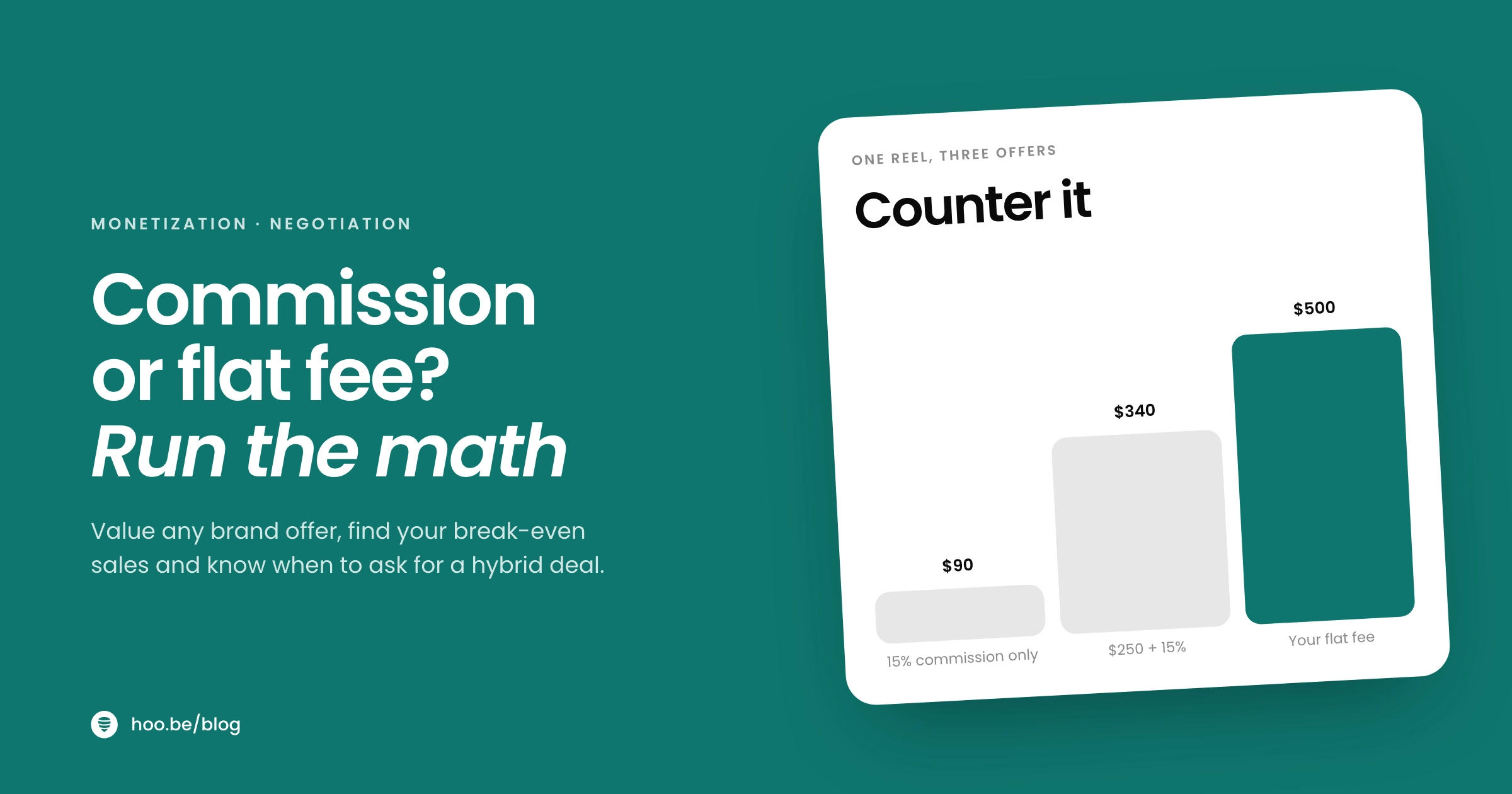
Here is a worked example. A brand offers 15% commission on a $50 product. A similar post sent 400 clicks, and about 3% of clickers bought. That is 12 orders × $50 × 15% = $90. If the same brand would pay $400 for the post, commission-only leaves $310 on the table, unless you expect this post to do far better than your last one.
What is the break-even point between commission and a flat fee?
A quicker test: divide the flat fee you would charge by what you earn per sale. That is how many sales the commission needs to drive just to match the fee.
| Product price | Commission | You earn per sale | Sales to match a $500 fee |
|---|---|---|---|
| $25 | 10% | $2.50 | 200 |
| $50 | 15% | $7.50 | 67 |
| $80 | 20% | $16.00 | 32 |
| $150 | 20% | $30.00 | 17 |
| $300 | 10% | $30.00 | 17 |
Worked example for illustration. Plug in your own fee, price and rate.
Now ask the honest question: has any single post of yours ever driven that many sales of one product? If the answer is no, the commission offer is worth less than your fee, and you should counter. If the answer is "regularly," commission may be the better deal.
Real programs show how wide the per-sale spread can be. Amazon pays 1% to 10% by category, LTK says its average brand commission is 16%, and ShopMy quotes 10% to 30%. A brand offering 5% on a $20 item needs 500 sales to match a $500 fee. That's rarely a fair trade for a dedicated post.

When should you take a flat fee?
Ask for a guaranteed fee, or at least a base fee, whenever the brand is getting value that doesn't depend on sales:
- The deliverables take real production. Scripts, shoot days, multiple revisions, set posting dates. That is work, and work gets paid regardless of outcome.
- The brand wants usage rights. If they will run your video as an ad, put it on their site or use it in email, they are licensing content. Licences are priced as a fee. See our guide to negotiating usage rights.
- There is exclusivity. Agreeing not to work with competitors costs you future income. Commission doesn't compensate for that.
- The product is new to your audience. Unknown brands and new launches convert less predictably.
- It is a considered purchase. Expensive items take days or weeks to decide on. Short attribution windows miss those sales. Amazon, for instance, only credits items added to the cart within 24 hours of a click.
- The brand won't share reporting. If you can't see clicks and sales, you can't check what you are owed.
- It's a UGC deal. If the content runs on the brand's channels, not yours, your audience isn't driving the sales, so commission makes little sense. Our UGC rates guide covers pricing.
When does commission make more sense?
Commission can beat a fee when the odds are on your side:
- You already use and talk about the product. The content is easy to make and sounds like you, so it converts.
- You have proof your audience buys. Past affiliate sales for similar products are the best predictor you have.
- The content is evergreen. A YouTube tutorial or a search-friendly review earns for months. The Influencer Marketing Factory's 2026 Brand Deals Report found affiliate structures make up 52.9% of YouTube brand partnerships, which average 13.5 months.
- The rate and price are high. At $30 per sale, the break-even arrives quickly.
- The effort is low. A link in your bio and an occasional mention, rather than a dedicated produced post.
- The commission keeps paying. Recurring commission on subscriptions, or a link that stays valid after the campaign, adds up over time.
Pro tip
Before accepting commission-only, ask the brand: "What do creators of my size typically sell on this offer?" A brand confident in its conversion will share a range. One that won't answer is telling you something about the risk.
What does a fair hybrid deal look like?
Hybrids let both sides win. You are paid for the work, and the brand pays more only when it gets more. The common structures:
| Structure | How it works | Good when |
|---|---|---|
| Base fee + commission | Reduced fee for the deliverables, plus a percentage of sales | Most deals; the default to propose |
| Fee + sales bonus | Fixed fee, plus set bonuses when sales pass agreed milestones | The brand dislikes open-ended commission |
| Tiered commission | Rate rises as sales grow (say 10%, then 15% past a threshold) | Long-term affiliate partnerships |
| Guaranteed minimum | Commission-only, but the brand guarantees a floor | The brand insists on commission |
| Cost per action | Fixed amount per sign-up, install or first order | Apps, subscriptions and services |
A practical starting point: if your fee for the post is $500, propose roughly half as a base plus the brand's standard commission on top. You are covered for the work, and a strong post earns more than the fee would have. Adjust the split depending on how confident you are in the sales.

What terms should you check in a commission deal?
A high rate means little if the fine print limits what you can earn. Get these in writing:
- The commission base. Is the rate on the full order, or after discounts, tax and shipping? Does it apply to the whole basket or only the linked item?
- Attribution window. How long after a click does a purchase count? Amazon uses 24 hours for adding to cart; brand programs vary widely. Longer is better for considered purchases.
- Link or code. Codes catch people who buy later on another device. Ask for both.
- Returns and cancellations. When does a pending commission become final, and are returned orders clawed back?
- Payout timing and minimums. Amazon pays about 60 days after the month ends. ShopMy pays weekly. Know when the money actually arrives.
- Reporting access. You should see clicks, orders and commission in a dashboard, not a monthly email.
- Duration. Does the link keep paying after the campaign? Can the brand change the rate later?
- Usage and exclusivity. Priced separately, as a fee, every time.
How do you counter a commission-only offer?
Most brands expect a counter. Keep it short, specific and friendly. This sequence works for most inbound offers:
- Thank them and confirm interest. Lead with the fit: why your audience and their product make sense together.
- Restate the deliverables. List exactly what they want: formats, number of posts, dates, revisions. It makes the work visible.
- Share one proof point. A past post's clicks, an affiliate result for a similar product, or your engagement rate. Your media kit should have it ready.
- Propose a hybrid. A base fee for the deliverables plus their commission. Give a number, not a range.
- Offer a lighter commission-only option. If they can't pay a fee, offer a link in your bio and a mention in organic content instead of a dedicated produced post. Less work for less guaranteed pay is a fair trade.
- Price extras separately. Usage rights, whitelisting and exclusivity get their own line.
For full email wording, our brand pitch templates include a negotiation reply. If you are still learning the basics of tracked links and programs, start with affiliate marketing explained for beginners.
How do you track whether a commission deal paid off?
After every deal, compare what you earned with the fee you would have charged. Over a few campaigns, this tells you which brands and categories are worth commission and which should always be fee-based.
- Clicks: from your bio link analytics and the brand's dashboard.
- Orders and commission: from the program or brand report.
- Effective fee: total commission divided by the number of deliverables.
- Tail earnings: what the link kept earning in the 30, 60 and 90 days after the campaign.
That record becomes your strongest negotiating tool. "My last commission partnership earned the equivalent of $X per post" is a far better argument for a fee than a follower count.
Keep campaign links where buyers find them
hoo.be puts brand links, affiliate picks and product blocks on one page, and its analytics show clicks per link, so you can see what each deal actually drove. Pro adds referrer, device and location breakdowns. Free to start.
Set up your hoo.be pageFrequently asked questions
Is it better to get paid a flat fee or commission as an influencer?
A flat fee is better when the brand wants produced content, usage rights or exclusivity, or when the product is new to your audience. Commission can pay more when you already use the product, have proof your audience buys it, and the content will keep earning, as on YouTube.
How do I know if a commission offer is fair?
Estimate expected earnings: clicks × conversion rate × average order value × commission rate. Then divide your usual fee by what you earn per sale to find break-even sales. If you can't realistically hit that number with one post, the offer is worth less than your fee.
What is a hybrid influencer deal?
A hybrid deal combines a guaranteed payment with performance pay, most often a base fee plus a commission on sales. Other versions include a fee plus sales bonuses, tiered commission rates or a guaranteed minimum. Hybrids share the risk between creator and brand.
What commission rate should I ask for?
It depends on the category. Amazon pays 1% to 10%, LTK reports a 16% average brand commission, and ShopMy quotes 10% to 30%. Compare any offer to those ranges, and focus on what you earn per sale, since a high rate on a cheap item can still pay very little.
Should I accept commission-only deals as a small creator?
Sometimes. Commission-only is fine for products you already use, with little extra work like a link in your bio. For a dedicated, produced post, ask for at least a small base fee. In impact.com's survey, 26% of creators preferred flat fees but only 19% received them.
Do usage rights change whether I should take commission?
Yes. Usage rights let a brand reuse your content in ads or on its own channels, and that value has nothing to do with your sales. Always charge a separate fee for usage rights, whitelisting and exclusivity, even when the rest of the deal is commission-based.
Sources
- Shopify, Affiliate marketing: how it works (citing impact.com's Global State of Affiliate Marketing 2025)
- impact.com, State of Affiliate Marketing Research Report 2025
- Lumanu, 2025 influencer compensation insights
- Digital Information World on the Influencer Marketing Factory 2026 Brand Deals Report (May 2026)
- Amazon Associates, standard commission income rates
- Amazon Associates Help, 24-hour window and shopping cart rules
- Amazon Associates program overview
- LTK, How it works for brands
- ShopMy for creators
- Shopify, How much do affiliates make (commission models)