In this article
- What is the difference between affiliate links and sponsored content?
- What are the pros and cons of affiliate links?
- What are the pros and cons of sponsored content?
- Which pays more: affiliate links or sponsored posts?
- How do you disclose affiliate links and sponsored posts?
- Should you choose affiliate or sponsored for a specific product?
- How can you use affiliate links and sponsored content together?
- Where should affiliate and sponsored links live?
- Frequently asked questions
Affiliate links pay you a commission on each sale you drive. Sponsored content pays you an agreed fee to create and post, whether or not anyone buys. That one difference shapes everything else: who carries the risk, who controls the content, how long it earns, and how you disclose it.
Neither is the "right" choice. Affiliate links are self-serve, evergreen and capped only by your audience's buying power. Sponsored posts are predictable and usually pay more per piece, but they come with briefs, approvals and rules. Most working creators run both, and the skill is knowing which one fits each post.
This guide compares the two side by side with 2026 data, covers the real pros and cons of each, explains how disclosure differs, and gives you a simple way to decide, plus a plan for using both on the same product.
Key takeaways
- Affiliate links pay per sale and can earn for months. Sponsored content pays a set fee for set deliverables.
- The average brand payment per deal was $1,645 across 255,000 creator payments analysed by Lumanu.
- Platform habits differ: affiliate structures make up 52.9% of YouTube brand partnerships, while about 70% of TikTok and Instagram deals are one-offs.
- Both must be disclosed under FTC rules. Platform labels help with sponsored posts, but affiliate links need your own clear wording.
- The strongest setup combines them: a paid launch post, then an affiliate link that keeps earning after the campaign ends.
What is the difference between affiliate links and sponsored content?
Start with what the brand is buying.
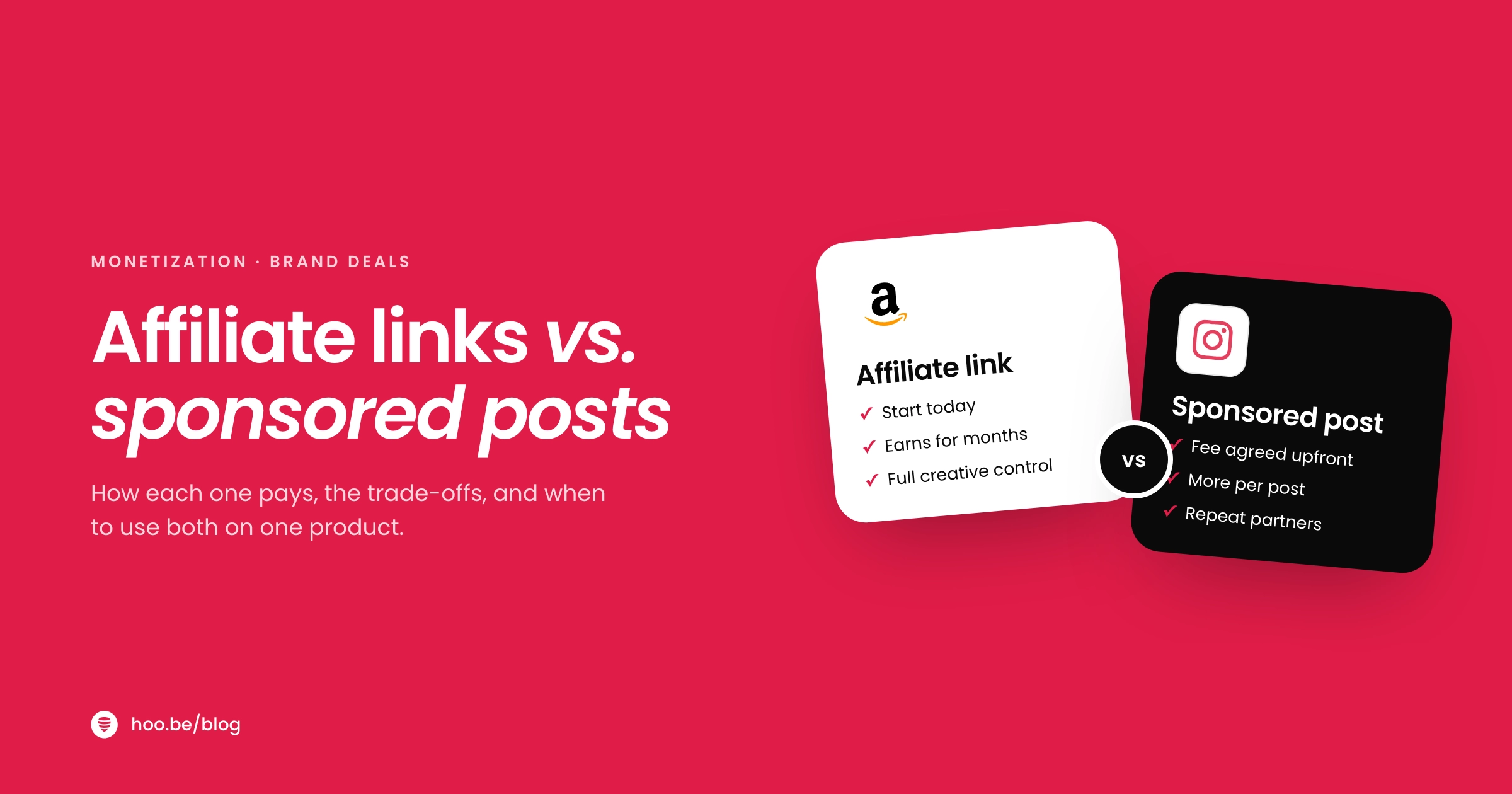
- With a sponsored post, the brand buys your work and your reach. You agree deliverables (say, one Reel and three Stories), a fee, dates and usage terms. You get paid for delivering, not for results.
- With an affiliate link, the brand buys results. You get a tracked link or code and a commission rate. You decide what to post and when. You get paid only when someone buys.
If you are new to how tracking and commissions work, read affiliate marketing explained for beginners first. This article assumes you know the basics and want to choose between the two models.
| Affiliate links | Sponsored content | |
|---|---|---|
| How you are paid | Commission per sale | Flat fee per deliverable |
| Who carries the risk | You | The brand |
| Barrier to entry | Low; join a program | Higher; pitch or get approached |
| Creative control | Yours | Shared; brief and approvals |
| How long it earns | As long as the link is live | Usually once, unless usage is licensed |
| Income pattern | Variable, compounding | Predictable, lumpy |
| Disclosure | Your own wording near the link | Platform label plus your own wording |
| Best for | Products you already use | Launches and planned campaigns |
What are the pros and cons of affiliate links?

Pros
- You can start today. No pitch, no media kit, no negotiation. Join Amazon Associates, LTK, ShopMy or TikTok Shop and link what you already recommend.
- It compounds. A tutorial or "my everyday kit" video keeps sending buyers for months. Every new link adds to the base.
- You keep creative control. No brief, no approval round, no talking points. Your audience hears your real opinion, which is why it converts.
- Upside is uncapped. If a post takes off, you earn on every sale it drives, not a fixed fee agreed before anyone saw it.
Cons
- Income is unpredictable. A great video about a product nobody needs right now can earn nothing.
- Rates can be small. Amazon pays 1% to 10% by category. On a $25 item at 3%, you earn 75 cents.
- Tracking leaks. Short attribution windows (Amazon credits items carted within 24 hours of a click), people switching devices, and buyers who search instead of tapping mean you won't get credit for every sale you influence.
- Payouts lag. Commissions wait for returns to clear, and some programs pay around 60 days after the month ends.
What are the pros and cons of sponsored content?

Pros
- Guaranteed pay. The fee is agreed before you post. If the post underperforms, you are still paid.
- Usually more per post. Lumanu's analysis of $420 million in creator payments found an average of $1,645 per deal, with Instagram Reels averaging $3,618. Few creators earn that from affiliate commissions on a single post.
- Relationships that repeat. In the same data, 80% of collaborations involved repeat payments with multiple deliverables. A good first campaign often leads to a second.
- Portfolio value. Recognisable brand work makes the next pitch easier. Our media kit guide shows how to present it.
Cons
- Harder to land. You need to pitch or be found, and brands look at reach, engagement and fit. See how to land your first brand deal.
- Less control. Briefs, talking points, revision rounds and posting dates. Too much of that and the post stops sounding like you.
- Extra terms to manage. Usage rights, whitelisting and exclusivity can tie up your content or your category. Price them separately; our guide to negotiating usage rights explains how.
- One-and-done income. The fee is paid once. When the campaign ends, the post usually stops earning.
Which pays more: affiliate links or sponsored posts?
Per post, sponsored content usually wins, especially at small and mid sizes where affiliate sales are modest. Over a year, affiliate can catch up, because each link keeps earning while sponsored income stops when the deliverables are done.
Platform habits make a difference too. The Influencer Marketing Factory's 2026 Brand Deals Report, built on 316,000+ creator accounts and 7,800 US creators, found clear differences in how deals are structured on each platform:
That pattern makes sense. YouTube videos are searchable and live for years, so a link in the description keeps earning, which suits commission. TikTok and Instagram posts burn bright and fast, so brands and creators tend to agree a fee for the moment. If most of your audience is on YouTube, lean toward affiliate and long partnerships. If it is on TikTok or Instagram, expect more flat-fee one-offs, and use affiliate links in your bio to catch the long tail.
Pro tip
Look at your own numbers before you choose. If a product you already link drives steady sales, you have proof your audience buys from you. That is leverage for a higher sponsored fee, or a reason to keep the affiliate link and skip the brief.
How do you disclose affiliate links and sponsored posts?
Both are material connections under US law, so both need disclosure. The FTC's guidance for influencers applies whether you were paid a fee, given a free product or earn a commission. What changes is how you do it.
Sponsored posts
Use the platform's branded content tool and your own words. YouTube, for example, asks you to tick a paid promotion box in your video details, which adds a disclosure label at the start of the video. The FTC still advises you not to assume a platform's tool is good enough on its own. Say it in the video and put "Ad" or "Sponsored" where people will see it before they tap "more."
Affiliate links
Platform labels are built for brand partnerships, so for affiliate links your own wording does the work. The FTC says consumers might not understand that "affiliate link" means you are paid, and suggests "paid link" next to the link, or a sentence like "I get commissions for purchases made through links in this post." If you are an Amazon Associate, you must also show "As an Amazon Associate I earn from qualifying purchases."
Disclosure is still widely missed. The same Influencer Marketing Factory report measured how much partnership content was properly disclosed on each platform:
Partnership content properly disclosed
Fewer than half of partnership posts on YouTube and Instagram were disclosed properly. Doing it right costs you nothing, protects you and the brand, and keeps your audience's trust, which is what makes both income streams work.
Should you choose affiliate or sponsored for a specific product?
Run each opportunity through these questions. The answers usually make the decision for you.
- Do you already use and recommend it? If yes, an affiliate link costs you nothing and keeps the content authentic. If a brand then offers a fee for a dedicated post, you can take that too.
- Will your audience buy it soon after seeing it? Impulse and problem-solving products convert well on commission. Big, considered purchases convert slowly and may fall outside short attribution windows, which favours a fee.
- How much work does the brand want? A script, multiple revisions, a shoot day or specific dates is production work. Production work should be paid upfront.
- Does the brand want rights to your content? If they plan to run it as an ad or on their own channels, that is a licence. It needs a fee, not just a commission.
- Is the product new to your audience? Unknown products are riskier on commission. A fee, or a fee plus commission, shares the risk fairly.
- Which platform is it for? Long-lived formats like YouTube suit commission. Fast feeds like TikTok and Instagram suit a fee, with an affiliate link in your bio for the tail.
When the answers point both ways, ask for a hybrid: a base fee plus commission. Our guide to affiliate commission vs flat fee walks through the deal math and the terms to check.
How can you use affiliate links and sponsored content together?
The best results usually come from stacking them on the same product, in sequence.
- Launch with a sponsored post. The brand pays for the big moment: the dedicated video, the review, the unboxing.
- Ask for a personal affiliate link or code as part of the deal. It costs the brand little, and it shows them sales they can attribute to you.
- Keep the link live after the campaign. Put it on your bio link page, mention it in future content, and let it earn long after the fee is spent.
- Use the results in your next negotiation. Sales data from the affiliate link is proof of what your audience does, and a reason to raise your fee next time.

Where should affiliate and sponsored links live?
On one page your audience can always find. When a sponsored post goes live, its link should sit at the top of your bio link for the campaign. When the campaign ends, it moves into your evergreen picks alongside your affiliate links. That page also doubles as a portfolio for brands, showing who you have worked with and what you recommend.
Track clicks on both. A sponsored link that gets heavy traffic is evidence for your next rate. An affiliate link that gets clicks but few sales may need a better product page or a different program. For a full checklist, see how to turn your link in bio into a revenue driver.
Run campaigns and affiliate picks from one page
hoo.be lets you put a campaign link at the top, keep affiliate picks in product blocks and carousels, and see which links get tapped in your analytics. Pro adds page scheduling and a scheduled redirect link for launch days. Free to start.
Create your hoo.be pageFrequently asked questions
What is the difference between affiliate marketing and sponsored content?
Affiliate marketing pays you a commission when someone buys through your tracked link, so you earn only on results. Sponsored content pays you an agreed fee to create and post content about a brand, regardless of how many sales it drives.
Is affiliate marketing or sponsored content better for small creators?
Affiliate marketing is easier to start because you only need to join a program, not land a deal. Sponsored content usually pays more per post once brands approach you. Most small creators start with affiliate links and add sponsored posts as their audience grows.
Do sponsored posts pay more than affiliate links?
Per post, usually yes. Lumanu's analysis of 255,000 creator payments found an average of $1,645 per deal. Affiliate links can catch up over time because they keep earning after you post, while a sponsored fee is paid once.
Do I need to disclose affiliate links the same way as sponsored posts?
Both must be disclosed under FTC guidance, but the method differs. Sponsored posts should use the platform's branded content tool plus your own clear wording. Affiliate links need your own wording near the link, such as "paid link" or "I earn a commission from purchases through these links."
Can a sponsored post include an affiliate link?
Yes, and it is a common setup. Many brands pay a flat fee for the post and add a personal affiliate link or code so they can track sales. You earn the fee upfront and a commission on sales, and the link can keep earning after the campaign.
Which platform is best for affiliate links?
YouTube is strongest for affiliate structures because videos stay searchable for years. The Influencer Marketing Factory found affiliate deals make up 52.9% of YouTube brand partnerships, while about 70% of TikTok and Instagram deals are one-off posts.
Sources
- Lumanu, 2025 influencer compensation insights ($420M across 255K payments)
- Digital Information World on the Influencer Marketing Factory 2026 Brand Deals Report (May 2026)
- FTC, Disclosures 101 for Social Media Influencers
- FTC, Endorsement Guides: What People Are Asking
- YouTube Help, Add paid product placements, sponsorships and endorsements
- Amazon Associates, standard commission income rates
- Amazon Associates Help, 24-hour window and shopping cart rules
- Amazon Associates Help, identifying yourself as an Associate
- Amazon Associates program overview