In this article
- What is affiliate marketing?
- How does affiliate marketing work, step by step?
- How much do affiliate programs pay in 2026?
- Which affiliate programs are best for beginners?
- How do you start affiliate marketing with no website?
- How do you disclose affiliate links correctly?
- How much can a beginner earn from affiliate marketing?
- What mistakes do new affiliate marketers make?
- Where should you put your affiliate links?
- Frequently asked questions
Affiliate marketing is a simple deal: you share a tracked link to a product, and when someone buys through it, the brand pays you a commission. You don't hold stock, ship orders or handle refunds. You recommend, the link records the sale, and the program pays you on a set schedule.
It is also one of the few ways to earn from content before you have a big audience. Amazon's program has no follower minimum, and most networks care more about trust and fit than reach. US advertisers are forecast to spend $13.81 billion on affiliate marketing in 2026, according to EMARKETER, so the money is there for creators who learn how it works.
This guide explains affiliate marketing from zero: who the players are, how tracking and commissions really work, what the main programs pay in 2026, how to start without a website, and how to disclose your links the way the FTC actually asks.
Key takeaways
- Affiliate marketing pays you a percentage of sales you refer through a unique link. No inventory, no upfront cost.
- Commission rates vary widely: Amazon pays 1% to 10% by category, LTK brands average 16%, and ShopMy quotes 10% to 30%.
- Tracking windows matter. Amazon only credits items added to the cart within 24 hours of a click on your link.
- You don't need a website. Amazon Associates accepts social creators, TikTok Shop opens at 1,000 followers, and YouTube Shopping at 500 subscribers.
- "Affiliate link" on its own may not be a clear enough disclosure, says the FTC. "I earn a commission" or "paid link" is safer.
What is affiliate marketing?
Affiliate marketing is performance-based promotion. A brand gives you a link or code that identifies you. When a follower uses it and buys, you earn a commission, usually a percentage of the sale. If nobody buys, you earn nothing, and the brand pays nothing.
Every affiliate sale involves four parties:
- The brand or merchant. The company that sells the product and sets the commission rate.
- The network or platform. The system that issues links, tracks clicks and sales, and pays out. Sometimes it is the retailer itself (Amazon Associates, TikTok Shop), sometimes a creator platform like LTK or ShopMy that connects you to thousands of brands.
- You, the affiliate. The creator who recommends the product and shares the link.
- The buyer. Your follower, who pays the normal price. The commission comes out of the brand's margin, not their pocket.
That last point is why affiliate marketing works so well for creators. You aren't asking anyone to pay more. You are getting credit for a purchase they were going to research anyway.

How does affiliate marketing work, step by step?
Under the hood, every program follows the same sequence. Knowing it helps you understand why some sales show up in your dashboard and others never do.
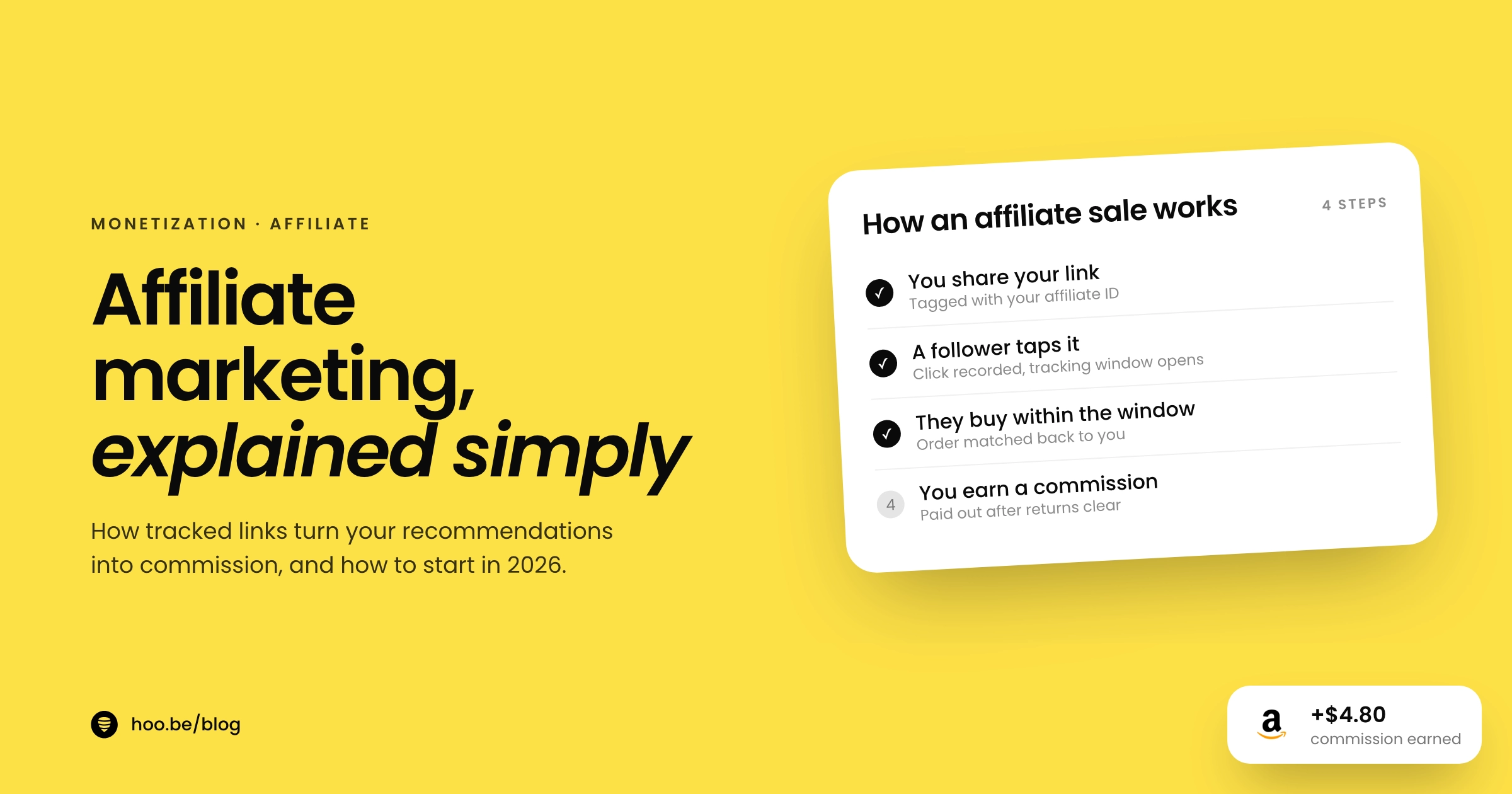
- You join a program and get a unique link. The link carries an ID or tag that says "this visitor came from you."
- A follower taps the link. The program records the click and starts an attribution window, the period during which a purchase counts as yours.
- The follower buys inside the window. The sale is matched back to your ID. If they come back a week later through a search, the sale may not count.
- The commission becomes pending. Programs hold it while returns and cancellations clear, then mark it as earned.
- You get paid. Payouts arrive on the program's schedule once you pass any minimum threshold.
The attribution window is the detail most beginners miss. On Amazon, you earn on qualifying items placed in the cart within 24 hours of the shopper arriving through your link. If they add an item in that window but check out later, you still earn as long as they buy before the cart expires, usually after 90 days. The window also closes if the shopper comes back through another creator's link.
Payout timing varies just as much. Amazon pays roughly 60 days after the end of the month in which you earned. ShopMy pays every Friday. Always check both before you decide how much effort a program deserves.
How much do affiliate programs pay in 2026?
Commission rates depend on the program and the product category, and the spread is huge. Physical goods on big retailers pay single digits. Curated creator platforms that work with premium brands pay more.
Amazon is the program most beginners join first, so it is worth knowing its rate card. These are Amazon's standard US commission rates by category:
Amazon Associates commission by category
Category matters more than most people expect. A $40 kitchen gadget at 4.5% earns you $1.80. A $40 luxury serum at 10% earns $4.00. Same price, same effort, more than double the payout. If you cover several niches, that alone can shape what you link.
Here is how the main creator programs compare:
| Program | Commission | Who can join | Payouts |
|---|---|---|---|
 Amazon Associates | 1% to 10% by category | Sites, apps and creators; 3 qualifying sales within 180 days of applying | About 60 days after month end |
 LTK | 16% average brand commission | Application; network spans creators from 5K to 5M+ followers | Through LTK when sales clear |
 ShopMy | 10% to 30% | Curated application | Weekly, every Friday |
 TikTok Shop | Set by each seller | 18+, 1,000 followers (US); pilot rules under 5,000 | Through TikTok Shop |
 YouTube Shopping | Set by each merchant | 500 subscribers plus watch-time rules, in 12 regions | Through YouTube |
Sources: Amazon Associates help pages, LTK brand page, ShopMy creator page, TikTok Shop creator eligibility policy, Social Media Today. As of October 2026.
Which affiliate programs are best for beginners?
Start with the program that matches where your audience already shops. You can add more later, but juggling five dashboards in month one is how people give up.
Amazon Associates: the easy first yes
Everyone has an Amazon account, checkout is familiar, and you earn on the whole cart, not just the item you linked. The catch is the short 24-hour window and the approval rule: once you apply, you have 180 days to refer three qualifying sales before Amazon reviews your account. Creators with an established social following can also look at the separate Amazon Influencer Program, which adds a storefront.
LTK and ShopMy: higher rates for style niches
If you post fashion, beauty, home or wellness, these platforms connect you to brands that pay more than a general retailer. LTK says its average brand commission is 16%. ShopMy quotes 10% to 30% and pays weekly. Both review applications, so a consistent niche and good photos help. Our guide to ShopMy sales from your link in bio covers setup.
TikTok Shop and YouTube Shopping: earn inside the app
These programs let viewers buy without leaving the platform. In the US, TikTok Shop affiliates must be 18 or older with at least 1,000 followers. Under 5,000 followers you start in a pilot for at least 30 days, limited to three shoppable videos a day and products from well-rated shops. YouTube lowered its Shopping affiliate entry point to 500 subscribers in March 2026. The TikTok Shop affiliate starter guide goes deeper.
How do you start affiliate marketing with no website?
You don't need a blog. Your content is the recommendation, and your link in bio is the storefront. Here is a simple plan for your first month.

- List 10 things you already use and love. Products you can talk about without a script convert better than anything you would pick for the commission.
- Join one program that sells most of them. Usually Amazon Associates, or LTK or ShopMy if your niche is style or beauty.
- Make one piece of content per product. A demo, a "what I use every morning" video, a before and after. Show the product working, then say where to find it.
- Put every link on one page. Your bio link should hold your current picks, grouped so people find them fast. Point every caption to it.
- Disclose clearly, every time. In the content and next to the link. More on the wording below.
- Check results weekly. Look at which links get clicks and which earn. Move the winners to the top and make more content about them.
Pro tip
Answer the question people already ask. If your comments keep asking "what mic is that?" or "where's that top from?", that product is your first affiliate link. Demand you can see beats a product with a high commission and no interest.
How do you disclose affiliate links correctly?
In the US, the FTC treats an affiliate commission as a material connection you must disclose, the same as a paid post or a free product. Its guidance for influencers is clear on three points.
- Use words people understand. The FTC notes that consumers might not understand that "affiliate link" means you get paid. It says "paid link" next to the link should be adequate, and suggests wording like "I get commissions for purchases made through links in this post."
- Put it where the recommendation is. Not buried behind "more," not only on your profile, not at the end of a long description. In videos, say it out loud and show it on screen.
- Platform tools help, but are not enough on their own. The FTC advises you not to assume a platform's disclosure tool is good enough, and to use it alongside your own.
Amazon adds its own rule. Associates must display the statement "As an Amazon Associate I earn from qualifying purchases," and for social content it has to be associated with your account. A line on your bio link page next to your Amazon picks, plus a spoken or written disclosure in each post, covers both. The FTC's Disclosures 101 for Social Media Influencers is a five-minute read worth doing once.
How much can a beginner earn from affiliate marketing?
Be realistic about the first year. Affiliate income compounds: every post and every link keeps working after you publish it, so early months look small and later months look very different.
The same Authority Hacker data shows how much time matters: affiliates with one to two years of experience averaged about $4,196 a month. Those figures skew toward full-time publishers, so treat them as a direction, not a promise. What they do show is that consistency, not a single viral post, is what builds affiliate income.
Three levers move your number more than follower count:
- Buying intent. A "best running shoes for flat feet" video converts far better than a lifestyle vlog with the shoes in the background.
- Commission rate and price. 10% of a $60 product beats 3% of a $25 one, as the Amazon chart shows.
- Friction. Every extra tap between your post and checkout loses buyers. One bio link, clearly labelled, with your top picks first.
What mistakes do new affiliate marketers make?
Linking everything
A page with 60 random products reads like an ad. A page with your eight genuine favourites reads like advice. Curate.
Promoting what pays, not what you use
Your audience notices when the recommendations change with the commission rate. Trust is the asset that makes every future link work, so protect it.
Ignoring the attribution window
If a program only credits sales within 24 hours, your link needs to be visible the moment people want to buy. Post the link with the content, not three days later.
Not tracking anything
Programs report sales. Your link in bio should report clicks. Put the two side by side each week and you will see which products deserve more content. Our link in bio audit walks through it.
Treating affiliate as the only option
Affiliate is one income stream. Once brands start reaching out, you will choose between commission and paid posts. Read affiliate links vs sponsored content to see how the two compare, and commission vs flat fee for how to price an offer when a brand proposes one.

Where should you put your affiliate links?
Most social apps make clickable links in captions hard or impossible, so your bio link becomes the main checkout path for affiliate income. A good one does a few things well:
- Shows your current favourites first, with clear product names and prices where possible.
- Groups the rest by category or by post ("Everything from my desk tour").
- Carries your disclosure on the page, next to the links.
- Tells you which links get tapped, so you can reorder them.
For more ideas on what belongs on that page, see what to add to your link in bio.
Give your affiliate picks one home
hoo.be product links recognise 30 shopping platforms, including Amazon, LTK, ShopMy, Etsy and Sephora, and there is a field for your Amazon affiliate tag. Link analytics show which picks get tapped. Free to start.
Build your hoo.be pageFrequently asked questions
What is affiliate marketing in simple terms?
Affiliate marketing means you share a unique link to a product, and the brand pays you a commission when someone buys through it. You don't stock or ship anything. The link tracks the sale back to you, and the program pays you on a set schedule.
Do you need a website to do affiliate marketing?
No. Many creators run affiliate marketing entirely through social content and a link in bio page. Amazon Associates accepts content creators, TikTok Shop and YouTube Shopping work inside the apps, and LTK and ShopMy are built for social creators.
How many followers do you need to start affiliate marketing?
It depends on the program. Amazon Associates has no follower minimum, but you need three qualifying sales within 180 days of applying. TikTok Shop requires 1,000 followers in the US, and YouTube Shopping opened to channels with 500 subscribers in March 2026.
How much does Amazon pay affiliates?
Amazon Associates pays 1% to 10% depending on category. Luxury beauty pays 10%, books and kitchen 4.5%, most other categories 4%, home and toys 3%, and grocery and health 1%. You earn on items added to the cart within 24 hours of a click on your link.
Is "affiliate link" a good enough disclosure?
Possibly not. The FTC says consumers might not understand that "affiliate link" means you are paid. It suggests "paid link" next to the link, or a plain sentence like "I get commissions for purchases made through links in this post," placed close to the recommendation.
How long does it take to make money with affiliate marketing?
Most beginners earn small amounts in the first months. In Authority Hacker's survey, affiliates in their first year averaged about $636 a month, rising to about $4,196 for those with one to two years of experience. Consistent content and a curated link page speed it up.
Is affiliate marketing better than sponsored posts?
Neither is better in every case. Affiliate links pay per sale and can earn for months, while sponsored posts pay a set fee upfront. Most creators use both. Affiliate links suit products you already recommend; sponsored posts suit planned campaigns with clear deliverables.
Sources
- Amazon Associates, standard commission income rates
- Amazon Associates Help, 24-hour window and shopping cart rules
- Amazon Associates Help, application review and qualifying sales
- Amazon Associates Help, identifying yourself as an Associate
- Amazon Associates program overview
- LTK, How it works for brands
- ShopMy for creators
- TikTok Shop Academy, Creator Eligibility Policy
- Social Media Today, YouTube expands Shopping affiliate access (Mar 2026)
- Shopify, Affiliate marketing: how it works (citing EMARKETER and impact.com)
- Shopify, How much do affiliates make (citing Authority Hacker) (Jun 2026)
- FTC, Disclosures 101 for Social Media Influencers
- FTC, Endorsement Guides: What People Are Asking