In this article
- Why do creators run out of content ideas?
- Where do you find content ideas when your mind is blank?
- How do you turn your past posts into new ideas?
- How do you use audience questions as content ideas?
- Which content formats work when you are stuck?
- How do you build an idea bank so you never start from zero?
- How do you test new ideas without risking your feed?
- What should you post on a day you still have nothing?
- Frequently asked questions
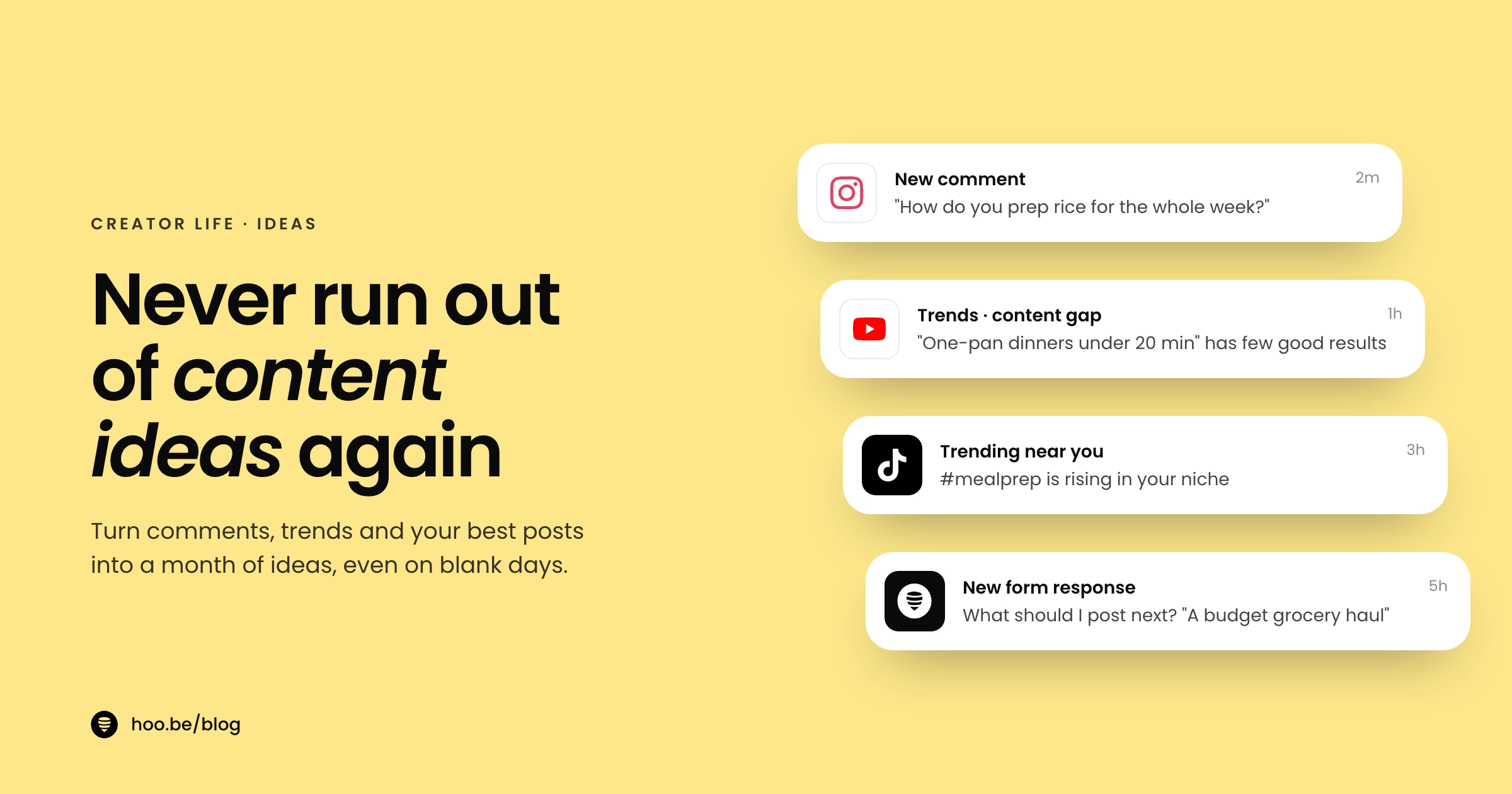
When you have no content ideas, the fix is not to wait for inspiration. It is to stop relying on it. The creators who post consistently pull ideas from four places that never run dry: their own analytics, their audience's questions, the trend tools every platform now provides, and a handful of repeatable formats they can fill with anything.
The stakes are real. Buffer's study of 2.1 million Instagram posts found that accounts posting three to five times a week got about 12% more reach per post than accounts posting once or twice. At that pace you need more than 150 ideas a year. Nobody has that many on demand. Everybody can have a system that produces them.
This guide gives you that system: where to look, which free platform tools to open, the formats that work when your mind is blank, and a 60-minute session that fills your idea bank for the month.
Key takeaways
- Running out of ideas is a system problem. Capture ideas in one place, every day, so you never start from a blank page.
- Your best future posts are hidden in your past ones. Rework your most saved, shared and commented posts from a new angle.
- Every comment and DM question is a post. Replying also helps: posts with replies saw 21% more engagement on Instagram in Buffer's 2026 data.
- Use the free trend tools: YouTube Studio's Trends tab shows content gaps, TikTok's Creative Center shows rising hashtags, and Instagram's Edits app shows trending reels.
- Borrow formats, not content. Ten fill-in-the-blank formats will carry you through any dry spell.
Why do creators run out of content ideas?
Usually for one of three reasons. You are trying to come up with ideas at the moment you need to post. You are only looking inside your own head. Or you are holding every idea to a standard of "completely original," which almost nothing on social media meets.
Consistency raises the pressure. In Buffer's 2025 study of more than 102,000 Instagram accounts, follower growth rose steadily with posting frequency, and weeks with no posts at all showed below-average growth.
Follower growth rate by posting frequency on Instagram
Buffer's own conclusion is that three to five posts a week is the sweet spot for reach and growth without burning out. That is the target this guide is built around: enough ideas to post three to five times a week, without forcing it.
Where do you find content ideas when your mind is blank?
Start outside your head. These are the sources that keep working, ranked roughly by how often they produce a usable idea.
| Source | What it shows you | Best for |
|---|---|---|
| Your top posts | Which topics your audience already saved, shared and commented on | Follow-ups, deeper dives, updates |
| Comments and DMs | The exact questions people are asking | Answer posts, FAQs, tutorials |
 YouTube Studio Trends tab YouTube Studio Trends tab | Your audience's top searches and content gaps from the last 28 days | Search-driven videos and Shorts |
 TikTok Creative Center TikTok Creative Center | Trending hashtags by country, with posts and views | Timely topics and trend formats |
 Instagram Edits app Instagram Edits app | Reels trending on Instagram, with views, likes and shares | Reels formats and audio |
 Pinterest Trends Pinterest Trends | Top search, save and shopping trends, up to two years back | Seasonal planning |
 Google Trends Google Trends | Relative search interest over time, scored 0 to 100 | Checking if a topic is rising or fading |
Tool details from each platform's help centre, checked October 2026. Some features are limited by country, language or account type.
YouTube: the Trends tab and Ask Studio
Open YouTube Studio, go to Analytics and pick the Trends tab. It shows the top searches from your audience over the last 28 days, breakout videos from channels similar to yours, and content gaps: searches where viewers cannot find enough good results. YouTube's own help page suggests using those gaps as inspiration for content that does not exist yet. A content gap is the closest thing to a guaranteed idea you will find.
YouTube's AI-powered Inspiration tab is being phased out from August 2026. YouTube now points creators to Ask Studio inside YouTube Studio for brainstorming. Treat any AI suggestion as a starting point and rewrite it in your own voice. Our guide on getting more views on YouTube covers how to turn a search term into a title.
TikTok: Creative Center trends
TikTok's Creative Center, now part of TikTok One, ranks the top hashtags in your country with post and view counts. You do not need to follow every trend. Look for hashtags that overlap with your niche and ask, "What would I add to this conversation?" TikTok's Creator Rewards Program also rewards search value, meaning content that matches in-demand search topics, so ideas that answer real searches pay off twice.
Instagram: Edits trending reels
In Meta's Edits app, the trending feed shows reels from public accounts that are trending on Instagram, along with their views, likes and shares. You can save a reel to your collections or create a sticky note to save the idea for a future project. That makes Edits a decent idea inbox if you already edit there. More on recent tools in new Instagram features you should know.

How do you turn your past posts into new ideas?
Look back before you look forward. Open your analytics, sort by saves and shares (not likes), and list your top ten posts from the past six months. Saves mean "I want this later." Shares mean "someone I know needs this." Both are strong signals that the topic deserves more.
For each top post, ask five questions:
- What is the next step? If the post taught a beginner skill, the follow-up teaches the intermediate one.
- What did I leave out? Every 30-second video skips details. Those details are a whole post.
- What changed? Prices, tools, rules and your own opinion all move. "Six months later" is a format.
- What went wrong? Mistakes and fixes are often more useful than the original tip.
- What did people argue about? Disagreement in the comments is a ready-made follow-up.
Ten top posts times five questions is fifty ideas, all on topics your audience has already proved it wants.
How do you use audience questions as content ideas?
Every repeated question is a post. If three people asked it, three hundred wondered it. Keep a running note on your phone and paste in every question from comments, DMs, live chats and emails. When the same question appears twice, it moves to the top of your list.
Answering also helps the post you are already on. In Buffer's 2026 engagement report, posts where the account replied to comments saw higher engagement: 21% higher on Instagram, 30% on LinkedIn and 42% on Threads. Replying is a growth habit and an idea-collection habit at the same time.
Pro tip
Ask for questions where people already land. Add a simple form to your link in bio with one field: "What should I make a video about next?" On hoo.be, a Forms block collects the answers and exports them to CSV, so your idea list fills itself between posts.
Which content formats work when you are stuck?
Good social ideas are rarely new ideas. They are familiar formats applied to your niche. When you are blank, pick a format first and the topic usually follows.
| Format | Fill in the blank |
|---|---|
| Things I wish I knew | "5 things I wish I knew before I started ___" |
| Myth vs. fact | "Everyone says ___. Here is what actually happens." |
| Before and after | "My ___ six months ago vs. today" |
| Mistakes | "3 ___ mistakes I see every week" |
| Tool or kit tour | "Everything I use to ___, under $___" |
| Day in the life | "What a real ___ day looks like" |
| Reaction or review | "I tried the viral ___ so you don't have to" |
| Step by step | "How to ___ in 4 steps" |
| Hot take | "Unpopular opinion: ___" |
| Question answer | "You asked: ___?" |
Rotate formats across the week so your feed does not feel repetitive, even when the topic is the same. This is the core of turning one idea into a week of posts.

How do you build an idea bank so you never start from zero?
Idea generation is uneven. Some days you will have ten, other days none. The trick is to collect on the good days so the bad days do not matter. Run this session once a week, ideally on the same day.
- Empty your inbox (10 minutes). Move every idea from your notes app, screenshots, saved reels and voice memos into one list. One list only.
- Mine your analytics (10 minutes). Add one follow-up idea for each of your top three posts from the past month.
- Mine your audience (10 minutes). Add every new question from comments, DMs and your link in bio form.
- Check one trend tool (10 minutes). YouTube Trends, TikTok Creative Center or Edits. Add two ideas that fit your niche and skip the rest.
- Match ideas to formats (10 minutes). Give every idea a format from the table above. An idea without a format is still just a topic.
- Pick next week's posts (10 minutes). Choose three to five, write the first line of each, and stop. Hooks are easier to write when you are not filming.
After a month you will have more ideas than you can use. That is the point. Our guide on why every creator needs a content strategy shows how to group them into content pillars.
How do you test new ideas without risking your feed?
Part of "no ideas" is really "no ideas I'm sure about." Lower the stakes. Instagram's trial reels let you share a reel only with people who do not follow you, check its views, likes, comments and shares, and then share it to everyone if it performs. You need a public professional account with at least 200 followers (1,000 for a personal account). Instagram notes that trial reels are ranked separately and do not affect your standard reels.
Two cautions from Instagram's help centre. Make a new reel for each trial, because a trial may get limited reach if Instagram detects you have shared the same content before. And reels longer than three minutes will not be recommended to new audiences, so keep trial ideas short.
On other platforms, use a lighter format as the test: a Story poll, a text post on Threads, or a short before you commit to a long video.
What should you post on a day you still have nothing?
Have an emergency list ready. These work on any account, any day:
- Repost a winner with a new hook. Re-edit an old high performer, change the first line, and post it as new content.
- Answer one comment on camera. Pin the comment on screen and answer it in under 60 seconds.
- Show your process. Film what you are working on right now. Behind-the-scenes content needs no script.
- Share a quick opinion. One thing in your niche you think people get wrong, and why.
- Roundup. Your three most useful posts this month, in one carousel, with a link to each.
And point people somewhere useful. A post that sends followers to your best older content keeps your library working long after it leaves the feed. Our guide to social SEO for creators explains how searchable posts keep earning views for months.

Let your link in bio collect ideas for you
hoo.be puts a question form, your best posts and embeds from TikTok, Instagram and YouTube on one page, with analytics that show which links people tap. Free to start.
Create your hoo.be pageFrequently asked questions
What should I post when I have no content ideas?
Rework a past post that got lots of saves or shares, answer a question from your comments or DMs on camera, or show what you are working on right now. These need no new idea, only a new angle on something your audience has already shown interest in.
How do I come up with content ideas every day?
Do not try to come up with them every day. Collect ideas continuously in one list, then run a weekly session to sort them into formats and pick the next three to five posts. A system beats daily inspiration.
Where can I find trending content ideas for free?
YouTube Studio's Trends tab shows your audience's top searches and content gaps. TikTok's Creative Center ranks trending hashtags by country. Instagram's Edits app has a feed of trending reels. Pinterest Trends and Google Trends show which searches are rising.
How often should I post on Instagram?
Buffer's study of 2.1 million posts found three to five posts a week is the sweet spot. Accounts posting that often got about 12% more reach per post than accounts posting once or twice a week, without the burnout of daily posting.
Is it OK to repost old content when I run out of ideas?
Yes, if you add something new. Re-edit it with a new hook, update the information, or answer a follow-up question. For Instagram trial reels, create a new reel rather than reusing one, because Instagram may limit the reach of content you have already shared.
Can AI help me come up with content ideas?
It can help you brainstorm. YouTube now points creators to Ask Studio in YouTube Studio for ideas, as its Inspiration tab is phased out from August 2026. YouTube itself warns AI suggestions can be inaccurate, so treat them as a starting point and rewrite them in your own voice.
Sources
- Buffer, How often to post on Instagram (Aug 2025)
- Buffer, State of Social Media Engagement 2026 (Mar 2026)
- YouTube Help, Explore trends on YouTube
- YouTube Help, Explore Inspiration tab on YouTube
- TikTok Creative Center, Trending hashtags
- TikTok Newsroom, Introducing the Creator Rewards Program (Mar 2024)
- Instagram Help, View trending reels on Edits
- Instagram Help, About trial reels on Instagram
- Instagram Help, Record a reel on Instagram
- Pinterest Help, Pinterest Trends
- Google Trends Help, FAQ about Google Trends data