In this article
- What are usage rights in a brand deal?
- Why do usage rights matter more in 2026?
- What types of usage rights do brands ask for?
- How much should you charge for usage rights?
- How do whitelisting, partnership ads and Spark Ads work?
- How do you negotiate usage rights step by step?
- Which contract clauses should you watch for?
- What do you say when a brand asks for more rights?
- Frequently asked questions
Usage rights decide what a brand can do with your content after you post it, and they are often worth more than the post itself. Your fee for creating a video should cover your own channel. Anything beyond that, such as running it as a paid ad, putting it on the brand's website, or keeping it forever, is a separate license you should price separately.
This matters more every year. The IAB expects US brands to spend $44 billion on creators in 2026, and more than half of that is expected to go into ads that amplify creators' content, not into creating it. Brands want your videos for their ads, and the contract is where that value is either paid for or given away.
This guide covers what usage rights are, the types brands ask for, what creators charge in 2026, how partnership ads and Spark Ads work, the contract clauses to watch, and scripts for the negotiation itself.
Key takeaways
- In the US you own the copyright in what you create, unless you sign it away in writing. A brand deal usually licenses your content; it should not transfer it.
- Every license needs four limits: channels, duration, territory, and whether it can run as a paid ad.
- A common model is 15% to 35% of your base rate per 30 days of paid usage. Broader bundles of usage, exclusivity and whitelisting can add 30% to 200%.
- TikTok Spark Ads codes last 7, 30, 60 or 365 days. Meta now lets creators set expiry dates on content permissions.
- Avoid "perpetual", "irrevocable" and "work made for hire" unless the price reflects owning your content forever.
What are usage rights in a brand deal?
Usage rights are permission for a brand to use content you created. Under US copyright law, copyright in a work "vests initially in the author", which means you, the creator, own your photos and videos by default. A brand only gets what you agree to give it.
There are two very different ways to give it:
- A license. You keep ownership and let the brand use the content in specific ways, for a specific time. This is what most creator deals should be.
- A transfer or buyout. You hand over ownership. Under US law, a transfer of copyright ownership is not valid unless it is in writing and signed by the owner. Treat any clause that "assigns" your rights as a sale of the content.
There is also a third route to watch for: "work made for hire". For independent creators, this only applies to certain kinds of commissioned work, including audiovisual works, when both sides sign a written agreement saying so. If that applies, the brand is treated as the author from day one and owns everything. Videos can fall into that category, so read for those exact words.
This guide is general information, not legal advice. For large or long-term deals, have a lawyer who works with creators review the contract.
Why do usage rights matter more in 2026?
Brands have discovered that creator content often makes better ads than their own. That shifts where the money goes.
Two more numbers show where the friction is. Aspire found 67% of brands now include paid usage in the creator's initial contract or rate, so it is often bundled in by default. And in CreatorIQ's survey of paid media leaders, 54% named "securing usage rights" as one of their biggest barriers. Brands need these rights, which gives you room to negotiate.
The platforms have built tools around it, too. In September 2026 Meta expanded its Creator Marketing Hub globally, combining creator discovery with partnership ads, and added content-level permissions that let creators set how long a brand can use a post.
What types of usage rights do brands ask for?
Most requests fall into one of these buckets. Each one is a separate line in your quote.
| Type | What the brand can do | How to price it |
|---|---|---|
| Organic repost | Share your post on its own social accounts, credited to you | Often included for a set period, such as 30 to 90 days |
| Owned channels | Use it on its website, product pages, emails or app | Add-on fee per term |
  Paid social from your handle | Run your post as an ad from your account (partnership ads, Spark Ads, whitelisting) | Percentage of base rate per 30 days |
| Paid ads from the brand's account | Cut your footage into its own ads | Percentage per 30 days, higher than organic |
| Offline and broadcast | TV, retail displays, billboards, print | Quote separately; it is a much bigger use |
| Raw footage | Get your unedited files to edit freely | Separate fee, plus clear limits on editing |
| Exclusivity | Stop you working with competitors for a period | Fee based on the income you give up |
| Perpetual or buyout | Use it forever, anywhere, or own it outright | A multiple of your base rate, if you agree at all |

How much should you charge for usage rights?
There is no official rate, but clear patterns have emerged. Aspire's 2026 research describes a percentage model of 15% to 35% of your base rate for every 30 days of usage, with 30-day windows as the norm. Nowadays Media's 2026 rate guide says usage rights, exclusivity and whitelisting together add 30% to 200% on top of base rates, and that paid amplification alone typically costs 30% to 100% more than an organic post.
Here is what creators told Aspire they actually charge for paid usage:
What creators charge for paid usage rights
The brand side looks similar. When brands pay extra for usage, 43% pay under $500, 14% pay $500 to $1,000 and 11% pay $1,000 to $2,500.
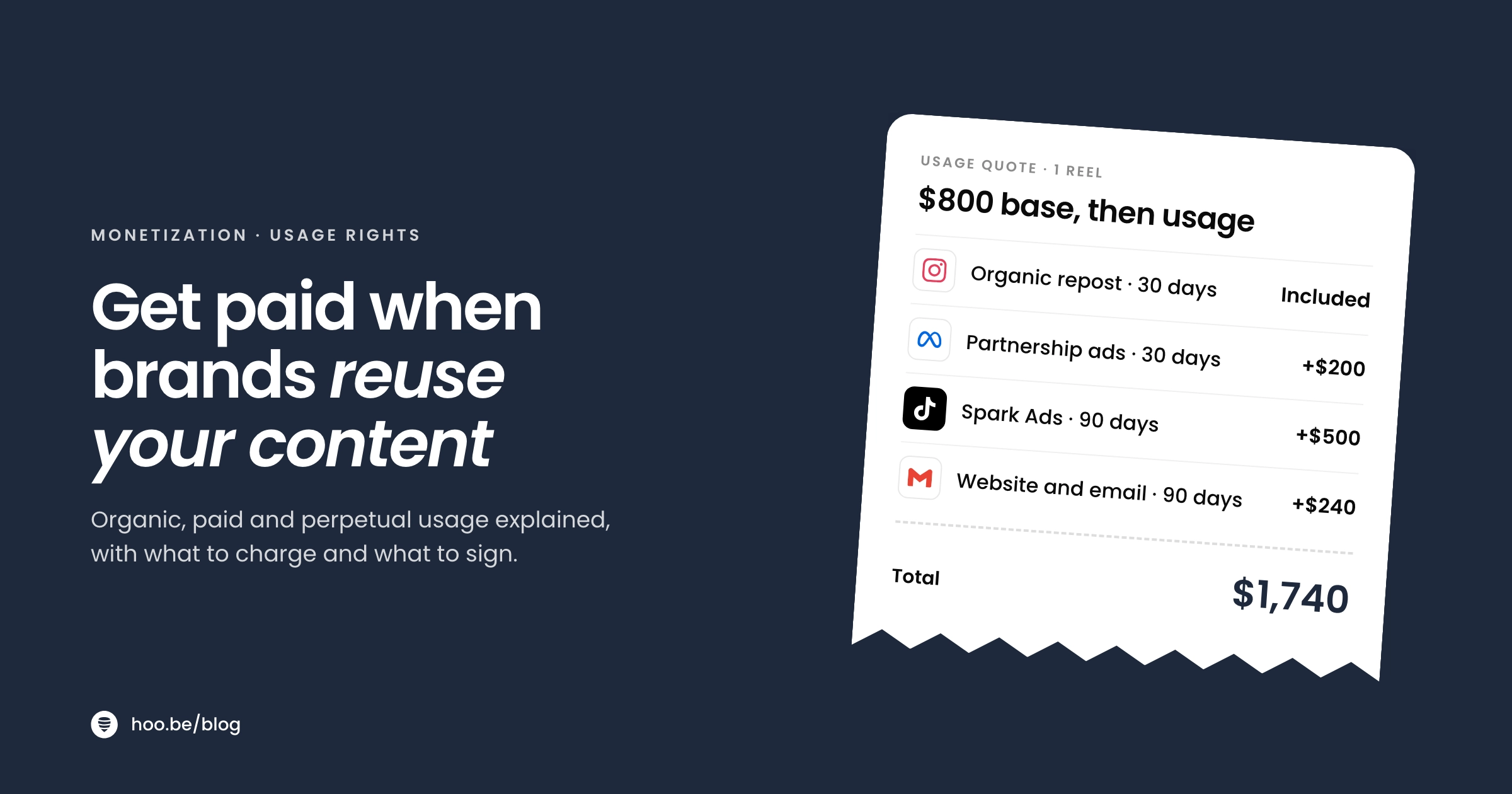
A worked example
Say your base rate for one Reel is $800 and the brand wants to run it as a partnership ad. Using Aspire's 15% to 35% per 30 days:
- 30 days of paid usage: $120 to $280 on top, so $920 to $1,080 in total.
- 90 days: $360 to $840 on top, so $1,160 to $1,640.
- A year: 12 months at those rates would be $1,440 to $3,360, which is why many creators offer a discounted annual price instead.
Where you land in that range depends on the brand's reach, how many channels it wants and how much it plans to spend. Some agencies price usage as a share of the ad budget instead: in a January 2026 Digiday report, a Wasserman executive described asking for 3% to 10% of the paid media budget behind the content.
Not sure what your base rate should be? Start with our UGC creator rates guide, or the rate section in how to land your first brand deal.
How do whitelisting, partnership ads and Spark Ads work?
When a brand runs your post as an ad from your handle, it is usually called whitelisting or allowlisting. Each platform handles permission differently, and the details affect what you should charge.
| Platform | Tool | How you grant access | How long it lasts |
|---|---|---|---|
Instagram,  Facebook | Partnership ads | Turn on "Get partnership ad code" under Partnership label and ads, then share the code | Until you turn the code off; content-level permissions can now carry an expiry date |
| TikTok | Spark Ads | Turn on Ad authorization in the post's Ad settings and share the code | 7, 30, 60 or 365 days |
From Instagram Help Center, Meta for Business (Sep 2026) and TikTok Ads Help Center, as of October 2026.
Three details from Meta's help center are worth knowing before you share a code:
- One ad code can be used by up to two partners at a time.
- Turning the code off stops new ads, but any active ads already using it keep running. Put the end date in your contract, not just in the app.
- Archiving the post does not stop a brand boosting it if the boost toggle is still on.
On TikTok, match the code's length to the term you sold. If you sold 30 days, do not generate a 365-day code. Partnership ads appear in Meta's Ad Library, so you can check whether your content is still running after the term ends.
Pro tip
Write the usage term into your contract as dates, not just "30 days". "Paid usage from March 1 to March 31, with an option to extend at [price] per 30 days" makes renewals easy and removes any question about when the clock started.
How do you negotiate usage rights step by step?
- Ask how the content will be used. Organic, paid or both? Which platforms? From your handle or theirs? On the website, in email, in stores?
- Ask for the term and territory. How long, and in which countries. "Worldwide" is common for social; still tie it to a time limit.
- Quote creation and usage as separate lines. "Reel: $800. Paid usage, 30 days: $200." Brands can then choose what they need instead of asking you to cut your rate.
- Offer tiers. 30, 90 and 365 days, each with a price.
- Price exclusivity on its own. Name the competitors or category and the period, and charge for the work you will have to turn down.
- Get it signed before you film. Deliverables, usage, term, territory, exclusivity, payment date and disclosure, all in one written agreement.

Which contract clauses should you watch for?
These phrases are where creators most often give away more than they meant to. None of them are automatically wrong, but each should change your price.
- "In perpetuity" or "irrevocable". Forever, with no way back. Ask for a term instead, or charge a buyout price.
- "All media now known or hereafter devised". Any channel, including ones that do not exist yet. Ask to list the channels.
- "Assign", "transfer" or "work made for hire". The brand would own your content outright. This is a sale, not a license.
- "Modify, edit or create derivative works". They can cut, re-voice or remix your content. Ask for approval over edits that change your message.
- Name, image and likeness. Limit use of your name and face to the content you made, for the agreed term. Ask that your likeness or voice is not used to create new content, including with AI tools, without a separate agreement.
- Raw files. Unedited footage is far more flexible for a brand. Price it separately.
- Payment tied to "approval". Cap the number of revision rounds and set a payment date that does not depend on open-ended sign-off.
Watch out
Under US law, a commissioned audiovisual work can be a work made for hire if both sides sign a written agreement saying so. If your contract uses that phrase, the brand becomes the legal author and owns every right. Do not sign it at a normal post rate.
What do you say when a brand asks for more rights?
Most brands expect a conversation. Keep it friendly and specific. These short scripts work by email.
When they ask for perpetual rights
"Thanks for sending this over. My rate covers creation and organic posting. For paid usage I offer 30, 90 or 365 days at [price], [price] and [price]. A full buyout is [price]. Which fits your plans best?"
When usage is bundled into a flat fee
"Happy to work within your budget. At [fee], I can include organic reposting for 30 days. Paid usage would be [price] per 30 days, so we can add it when you know which posts you want to run."
When your content is still running after the term
"Great to see the [month] Reel is still running. Our agreement covered paid usage through [date]. I would be glad to extend for another 30 days at [price]. Shall I send an updated agreement?"
Clear terms are not confrontational. They help the brand know exactly what it can use and save both of you an awkward conversation later. If a brand prefers a sales commission over usage fees, read affiliate commission vs. flat fee to compare the two.

Show brands what your content is worth
hoo.be gives you one page for your best posts, your media kit and a brand inquiry form, with analytics that back up your rates. Start free.
Claim your hoo.bePro plans on hoo.be add 90-day and all-time analytics with referrer, device, country and city breakdowns, which help you show a brand who sees your content when you are pricing usage. Our creator media kit guide shows how to present it, and our brand pitch templates help you start the conversation.
Frequently asked questions
What are usage rights for influencers?
Usage rights are the permission a brand gets to use content a creator made, beyond the creator's own post. A usage clause should set the channels (organic, paid ads, website, offline), the duration, the territory, and whether the brand can edit the content.
How much should I charge for usage rights?
A common 2026 model is 15% to 35% of your base rate for every 30 days of paid usage, according to Aspire. Nowadays Media puts usage, exclusivity and whitelisting together at 30% to 200% on top of base rates. Perpetual rights or a buyout should cost a multiple of your base rate.
Who owns content made for a brand deal?
In the US, the creator owns the copyright by default. A brand only owns it if you sign a written transfer, or if you sign a written work-made-for-hire agreement for a qualifying work, such as an audiovisual work. Most creator deals should be a time-limited license instead.
What is the difference between whitelisting and usage rights?
Usage rights cover how a brand may use your content. Whitelisting is one kind of usage: the brand runs your content as a paid ad from your handle, using tools like Meta partnership ads or TikTok Spark Ads. It is usually priced separately and per 30 days.
How long do TikTok Spark Ads codes last?
When you turn on ad authorization for a TikTok post, you can choose 7, 30, 60 or 365 days. Match the length to the usage term in your contract.
Can I revoke a Meta partnership ad code?
You can turn the code off, which stops it being used to create new ads. According to Meta's help center, active ads already using the code keep running, so set the end date in your contract as well.
Should I ever agree to perpetual usage rights?
Only if the price reflects it. Perpetual rights mean the brand can use your content forever, often across channels and countries. Offer 30, 90 and 365-day options first, and quote a separate buyout price if the brand insists.
Sources
- 17 U.S.C. § 201, Ownership of copyright (Cornell LII)
- 17 U.S.C. § 204, Execution of transfers of copyright ownership (Cornell LII)
- 17 U.S.C. § 101, Definitions, including "work made for hire" (Cornell LII)
- Digiday, Brands are spending more to advertise creators' content, making usage rights a focal point (Jan 2026)
- Aspire, How brands and creators are navigating content usage rights in 2026 (Feb 2026)
- CreatorIQ, Creator content now powers 44% of paid media creative (Jun 2026)
- Nowadays Media, Instagram Influencer Rates 2026 (Jun 2026)
- Meta for Business, Making it easier for businesses to partner with creators (Sep 2026)
- Instagram Help Center, Create a partnership ad code to share with partners
- TikTok Ads Help Center, How to create Spark Ads
- IAB, 2025 Creator Economy Ad Spend & Strategy Report (Nov 2025)