In this article
- How much do UGC creators charge in 2026?
- What affects how much you can charge for UGC?
- How to set your first UGC rate
- How much should you charge for usage rights and whitelisting?
- Marketplace or direct clients: which pays more?
- How to build a UGC quote, step by step
- When should you raise your UGC rates?
- Contracts, disclosure and taxes
- Show brands why you are worth your rate
- Frequently asked questions
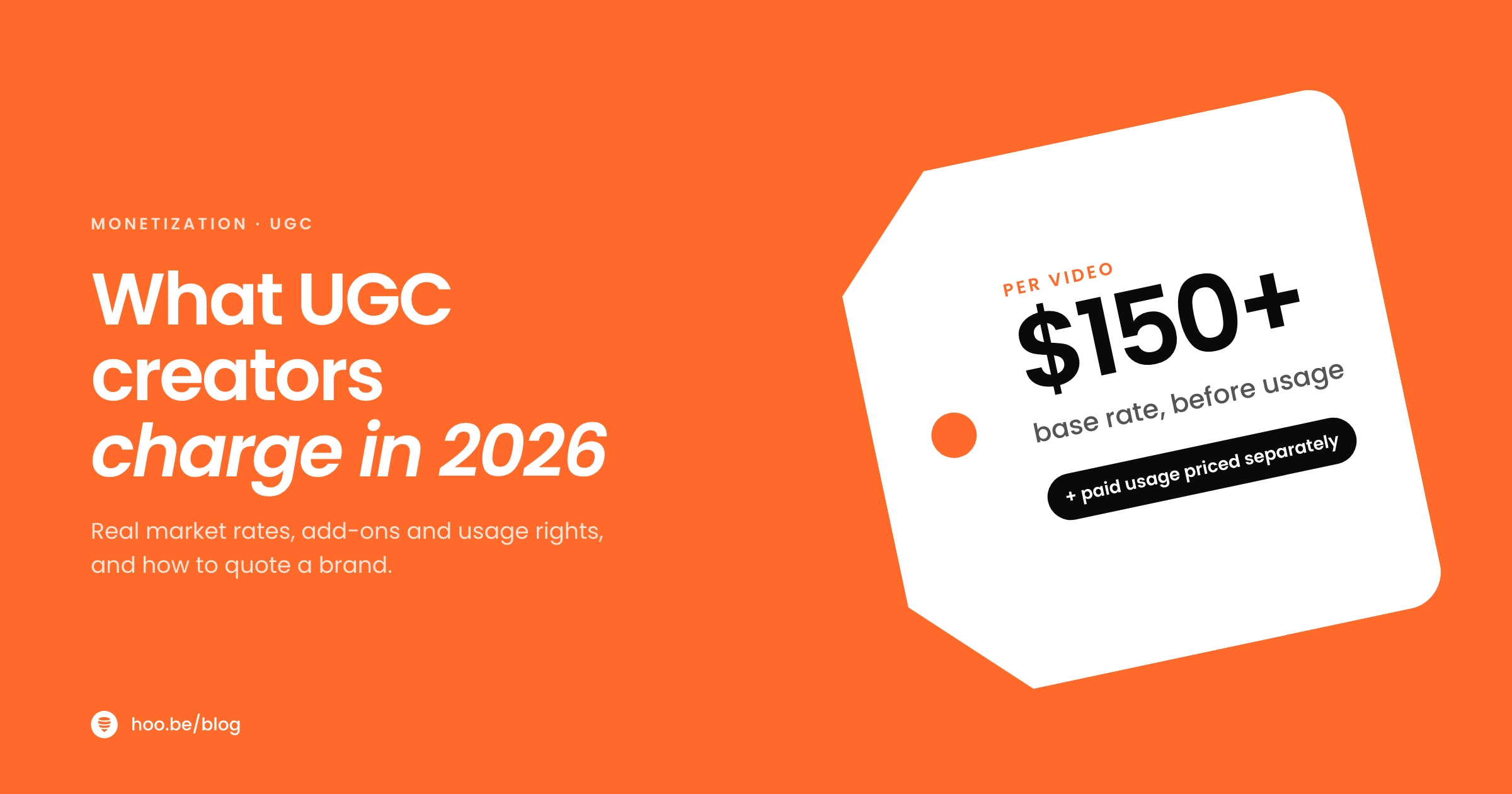
Most UGC videos in 2026 sell for under $500 each, and the market average sits around $150 to $200 per video. On Collabstr, one of the largest creator marketplaces, the average UGC collaboration paid $154. In Influencer Marketing Hub's 2026 survey, about 80% of brands' answers on UGC creator pricing landed under $500.
The base video is only part of the price, though. What brands really pay for is scope: how many videos, how many hooks, how much editing, and above all how long and where they can run your content as an ad. That is where experienced creators earn more, and where beginners give away the most for free.
This guide gives you real 2026 benchmarks, a simple way to set your first rate, what to charge for usage rights and add-ons, and how marketplace pay compares with working with brands directly.
Key takeaways
- The average UGC collaboration on Collabstr paid $154 in its 2026 report, and roughly 80% of brand UGC budgets per creator sit under $500.
- Marketplaces pay less but bring you work: Billo's base payout for a 15-second video starts at $30 for new creators and $70 for premium creators.
- Price the base video, then add hooks, raw footage, usage rights and whitelisting as separate line items.
- Paid ad usage typically adds 30% to 50% for a short license, and whitelisting is often priced at around 30% of the base fee per month.
- Raise your rate when your portfolio, speed or ad results improve, not when your follower count does.
How much do UGC creators charge in 2026?
UGC pricing has settled into a clear range as more creators and brands have joined the market. Here are the most reliable 2026 data points.
Collabstr's report also shows how UGC compares with posting on your own account. Because brands are paying for content rather than reach, UGC pays not far below the average Instagram or TikTok collaboration on the platform, even though the creator brings no audience.
Average payout per collaboration on Collabstr
Two trends matter for your pricing. First, demand is rising: UGC collaborations on Collabstr grew 133% and now make up 35% of campaigns. Second, prices per piece are slipping, with the average cost of UGC campaigns down 5.7% year over year, from $209 to $197. More buyers, more sellers and lower average prices mean the creators who stand out on quality and scope are the ones who hold their rates.
What affects how much you can charge for UGC?
Two videos that look similar can be worth very different amounts. These are the factors that move your price most.
- Length and complexity. A 15-second product demo takes less time than a 60-second scripted testimonial with several scenes.
- Concepting and scripting. If you write the brief, hooks and script, that is strategy work. Charge for it.
- Editing. Captions, cuts, b-roll and music add hours. Raw clips for the brand to edit are a different product.
- Revisions. Include one round. Charge for more.
- Usage rights. Organic posting on the brand's page is the baseline. Paid ads, longer terms and more channels cost more.
- Turnaround. Rush jobs inside a few days usually carry a premium.
- Niche and skills. Skincare results, tech walkthroughs, recipes and fitness demos need credibility or skill, and brands pay for it.

How to set your first UGC rate
If you are brand new, start from the market, not from what feels comfortable. The benchmarks above give you a sensible starting band.
| Where you are | Suggested base rate per video | Why |
|---|---|---|
| Marketplace tasks, first month | Set by the platform, e.g. $30 to $70+ on Billo | You trade price for a steady flow of briefs and fast portfolio building |
| First direct clients | $100 to $175 | Close to the $154 Collabstr average, while your portfolio is still small |
| Proven portfolio | $175 to $350 | Strong samples, fast delivery and repeat clients |
| Ad results you can show | $350 to $500+ | You can point to ads that performed, and brands pay for that confidence |
The direct-client bands are hoo.be's suggested starting points, set against the Collabstr, Billo and Influencer Marketing Hub data in this article. They are not survey results.
Charge per deliverable, not per hour, and offer a small discount for bundles. Brands often want three to five videos to test different angles, so a three-video package is a good default offer.
Pro tip
Quote a base price that you are happy with even if the brand adds nothing else. Then list hooks, raw footage and usage rights as add-ons underneath. Brands see a fair entry price, and you get paid properly for everything extra they choose.
How much should you charge for usage rights and whitelisting?
Making a video and licensing it for paid ads are two different things. When a brand puts money behind your content, it can reach millions of people for months. Your price should reflect that.
| Add-on | Common 2026 pricing | What it means |
|---|---|---|
| Extra hooks | About $50 each | Alternative first 3 seconds so the brand can test openings |
| Raw footage | 30% to 50% of base | Unedited clips the brand can recut |
| Paid usage rights | 30% to 50% of base for a short term | The brand runs your video as an ad from its own account |
 Spark Ads or  partnership ads | About 30% of base per month | The ad runs from your handle, so it uses your name and profile |
| Rush delivery | 25% to 50% of base | Turnaround faster than your standard timeline |
| Exclusivity | Priced by category and length | You cannot work with competitors for a set period |
Sources: inBeat's 2026 UGC rate guide for add-on ranges. Nowadays Media puts usage rights, exclusivity and whitelisting at 30% to 200% on top of base rates, depending on scope.
How whitelisting works on TikTok and Instagram
On TikTok, brands run creator videos as Spark Ads. You open the video, tap the three dots, go to Ad settings and generate an authorization code, then send the code to the brand. TikTok lets you set how long the authorization lasts, which is why your price should be tied to that period. All likes, comments and follows from the ad count toward your original post.
On Instagram and Facebook, the equivalent is partnership ads. You need a professional (creator or business) account, and branded posts must carry the Paid Partnership label. Agree the length of access in writing before you approve the request.
Either way, agree three things up front: which platforms, how long, and whether the brand may edit your video. Our guide to negotiating usage rights has scripts for each.
Marketplace or direct clients: which pays more?
Direct clients almost always pay more per video. Marketplaces pay you less but solve the hardest part of being new: finding work.
| Route | How pay works | Best for |
|---|---|---|
| Billo | Fixed payout per task, shown before you apply; no negotiation on the base rate; paid twice a month via PayPal | Building a portfolio fast with steady briefs |
| Collabstr | You list your own packages and prices for brands to book | Setting your own rates with built-in brand demand |
| Direct outreach | You set the scope, price and usage terms | Higher rates, repeat clients and long-term retainers |
Billo says its creators earn about $500 a month on average, with active creators earning two to three times that. Billo does let creators set their own price for organic posting on their account and for partnership ads, so you can still earn more on the add-ons. A sensible path is to use a marketplace for your first month or two, then move your best clients and your time toward direct work.

How to build a UGC quote, step by step
- Read the brief and ask questions. Number of videos, length, formats, who writes the script, deadline, and where the content will run.
- Price the base videos. Use your rate per video, with a small discount for bundles of three or more.
- Add production extras. Hooks, raw footage, extra edits and rush delivery as separate lines.
- Add usage. Organic only, or paid ads? For how long, on which platforms? Whitelisting or Spark Ads priced per month.
- Set terms. One revision round included, payment terms (consider asking new clients for 50% upfront), and what happens if the brief changes.
- Send it as a clear package. One total, the line items beneath, and a date the quote is valid until.
- Get it in writing. A short agreement covering deliverables, usage, payment and deadlines protects both sides.
When should you raise your UGC rates?
Raise your rates when the value of your work goes up, not on a calendar. Good signals:
- You are booked several weeks ahead, or turning down briefs.
- Clients come back for second and third orders.
- A brand shares that your ad outperformed their others. Ask for the numbers and add them to your portfolio.
- You have added a skill, such as scripting, motion graphics or on-camera presenting.
Apply new rates to new clients first, and give existing clients notice. A 15% to 25% step is easier to accept than doubling overnight. If a client cannot meet your new rate, offer a smaller scope instead of a discount.
Contracts, disclosure and taxes
UGC is usually published by the brand, so the brand is the advertiser. If you also post the video on your own account, the FTC expects a clear disclosure such as "#ad" or "Paid partnership" with the post itself, and that includes free products. The FTC's rule on fake reviews, finalized in 2024, also bans testimonials that misrepresent the speaker's real experience with a product. Only say you use something if you do.
In the US, UGC income is self-employment income. The IRS self-employment tax rate is 15.3% (Social Security plus Medicare), and you must file once your net earnings reach $400 in a year, on top of income tax. Set aside a share of every payment, and talk to an accountant once the work is regular.
Show brands why you are worth your rate
Brands decide on your rate in the first minute, when they look at your samples. If your portfolio is a scattered folder of files, your price looks high. If it is one clean page with your best videos playing, your niches, your services and a quick way to get in touch, the same price looks fair. Our guides on building a media kit and turning your link in bio into a portfolio show how.
Put your UGC portfolio in one link
With hoo.be, you can embed your best TikToks, Reels and YouTube Shorts, add a brand inquiry form with the fields you need, and export the responses to CSV. Link it from your bio and your pitch emails. Free to start at hoo.be.
Build your portfolio pageNew to UGC? Start with your first 30 days as a UGC creator, and read UGC creator vs influencer to see which path fits you.
Frequently asked questions
How much should a beginner UGC creator charge?
A sensible starting rate for direct clients is around $100 to $175 per short video, close to the $154 average UGC payout on Collabstr. On marketplaces the platform sets the rate: Billo's base payout for a 15-second video starts at $30 for new creators.
What is the average price of a UGC video in 2026?
Collabstr's 2026 report puts the average UGC collaboration payout at $154, and the average cost of UGC campaigns at $197, down 5.7% from $209. In Influencer Marketing Hub's 2026 survey, about 80% of brand answers on UGC creator pricing were under $500.
How much should I charge for UGC usage rights?
A common approach is to add 30% to 50% of your base fee for a short paid-ad license, and more for longer terms or more channels. Nowadays Media puts usage, exclusivity and whitelisting at 30% to 200% on top of the base rate, depending on scope.
What is whitelisting in UGC and how much does it cost?
Whitelisting lets a brand run ads from your account, using your handle. On TikTok it uses Spark Ads authorization codes, and on Instagram and Facebook it uses partnership ads. It is often priced at around 30% of your base fee per month.
Do you need followers to charge for UGC?
No. UGC is priced on production, not audience, because the brand posts the content. Billo, for example, says follower count is irrelevant for its creators. Your portfolio and reliability decide your rate.
Should UGC creators charge per video or per hour?
Per video, with add-ons listed separately. Brands budget per deliverable, and per-video pricing rewards you for getting faster. Offer bundle discounts for three or more videos.
How much do Billo creators make?
Billo's base payout for a 15-second video starts at $30 for new creators and $70 for premium creators, and rises with video length and add-ons. Billo says its creators earn about $500 a month on average, paid twice a month via PayPal.
Sources
- Net Influencer, Collabstr report: TikTok campaigns plummet as brands pivot to UGC (Jan 2026)
- Storyboard18, 80% of influencer deals under $300 as brands shift to UGC (Mar 2026)
- Influencer Marketing Hub, Influencer Marketing Benchmark Report 2026 (May 2026)
- Billo, How to become a UGC creator in 2026 (Sep 2026)
- Billo Help Center, For creators: getting started guide
- Billo Help Center, Creator eligibility for Meta partnership ads
- inBeat, The ultimate guide to UGC rates in 2026 (Aug 2026)
- Nowadays Media, Instagram Influencer Rates 2026 (Jun 2026)
- TikTok Ads Manager Help, About Spark Ads
- TikTok Ads Manager Help, How to create Spark Ads
- FTC, Disclosures 101 for Social Media Influencers
- FTC, Final rule banning fake reviews and testimonials (Aug 2024)
- IRS, Self-employment tax (Social Security and Medicare taxes)