In this article
- Why shouldn't creators rely only on brand deals?
- What are the best ways to make money besides brand deals?
- How do you choose which income stream to start with?
- How do you set up your link in bio to earn from every stream?
- How do you keep creator income stable?
- What rules apply to affiliate links, tips and products?
- Frequently asked questions
Brand deals are still the biggest single paycheck for most creators. In Influencer Marketing Hub's survey of more than 3,000 creators, 49% name brand deals as their main revenue stream. But brand budgets move with the season and the economy, and a creator who lives on sponsorships alone has a slow month every time a brand pauses spend.
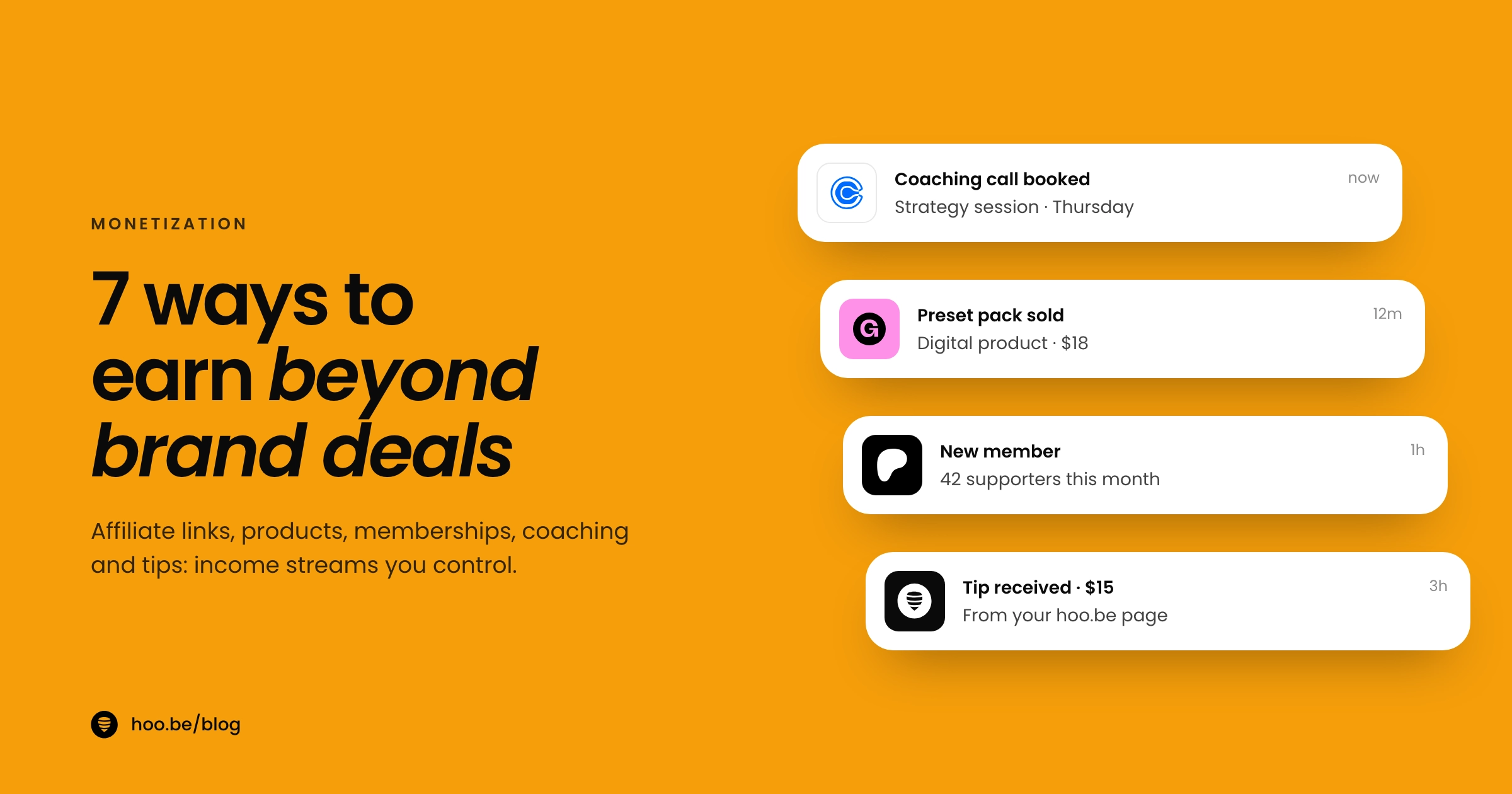
The creators who earn the most do not just win more deals. They run more streams. In Creator Spotlight's 2025 monetization survey, creators earning six figures ran 3.3 income streams on average, against 2.2 for creators earning under $500. The seven streams below are the ones you can add without waiting for a brand to say yes: affiliate links, digital products, platform payouts, memberships, coaching, your own products and direct tips.
For each one you will find what it takes to start, what the platforms actually take from you in 2026, and how to send your audience to it from one link in bio.
Key takeaways
- Seven income streams work without a brand deal: affiliate links, digital products, platform payouts, memberships, coaching, your own products and tips.
- Top earners run more streams: 3.3 on average for six-figure creators, against 2.2 for creators earning under $500.
- Affiliate links are the easiest start. Amazon pays 1% to 10% by category, and ShopMy brands typically pay 10% to 30%.
- Fees vary a lot. Gumroad takes 10% + $0.50 per direct sale, Patreon takes 10% plus processing, and TikTok subscriptions pay up to 90% in the US and Canada.
- Creators who own their audience through an email list were 2.7 times more likely to earn $31,000 or more.
Why shouldn't creators rely only on brand deals?
Brand deals pay well per post, but you do not control the calendar. You wait for inbound, you negotiate, you deliver, and then you start again. When budgets tighten, deals are the first line item brands cut or delay.
The pattern at the top is clear. Creators with several streams have a floor under their income. A slow sponsorship month still has affiliate commissions, product sales and memberships coming in.
Average number of income streams, by annual creator income
You do not need all seven. You need two or three that fit your audience, set up so followers can reach them in one tap. If you are still working toward your first sponsorship, our guide on landing your first brand deal pairs well with this one.
What are the best ways to make money besides brand deals?
Here is how the seven streams compare before we go through each one.
| Income stream | Audience needed | What the platform takes | Effort |
|---|---|---|---|
| Affiliate links | Low:  Amazon Associates publishes no follower minimum;  ShopMy typically looks for 1,000 | You earn 1% to 30% of each sale, set by the program | Low, ongoing |
| Digital products | Any audience that trusts you on one topic |  Gumroad: 10% + $0.50 per direct sale | High upfront, then low |
| Platform payouts |  YouTube: 1,000 subs + 4,000 hours;  TikTok: 10,000 followers | Revenue share set by each platform | Medium |
| Memberships | A core of engaged fans |  Patreon: 10% plus processing; TikTok: you keep up to 90% | Medium, ongoing |
| Coaching and consulting | Small is fine if you have expertise | Only your booking and payment tools | High per hour |
| Your own products and merch | A loyal community | Your production and shipping costs | High |
| Tips and direct support | Any |  hoo.be: 0% to 9% by plan, plus  Stripe 2.9% + $0.30 | Low |
Fees from each platform's official pricing or help pages, checked October 2026. Processing fees are extra unless stated.
1. Affiliate marketing
You share a tracked link to a product you already use, and you earn a commission when someone buys. It is the easiest stream to start because there is no product to make and no brand to pitch. If followers already ask "where is that from?", you are leaving money on the table every time you answer without a link.
Rates depend on the program. Amazon Associates pays 1% to 10% by category: 10% on luxury beauty, 4.5% on kitchen and physical books, 4% on apparel and shoes, 3% on beauty, home and toys, and 1% on grocery and health. ShopMy commissions typically run 10% to 30%, set by each brand, and ShopMy pays out every Friday through PayPal or Stripe once you have at least $11 ready to pay.
Start with the program that matches what you post. Our guides to the Amazon Influencer Program, ShopMy and the TikTok Shop affiliate program cover the setup, and affiliate marketing explained for beginners covers the basics.
Pro tip
Build one evergreen "things I actually use" collection and one rotating "recently mentioned" collection. The first earns quietly all year. The second matches what you just posted, so followers who tap through from a video find the exact item.
2. Digital products
Templates, presets, guides, workout plans, recipe books and courses. You make it once and sell it many times, with no inventory and no shipping. The best first product is the answer to the question you get asked most in your DMs, packaged so someone can use it today.
Check the fee before you pick a store. Gumroad charges 10% + $0.50 per sale through your own profile or links, and 30% when a buyer finds you through its Discover marketplace. On hoo.be, the Product block lets you list an item with a price and a shop button directly on your page.

3. Platform payouts
Most big platforms share revenue once you hit their thresholds. YouTube's Partner Program opens at 1,000 subscribers plus 4,000 public watch hours in 12 months, or 1,000 subscribers plus 10 million Shorts views in 90 days. TikTok's Creator Rewards Program needs 10,000 followers and 100,000 views in the last 30 days, and only pays on videos longer than a minute.
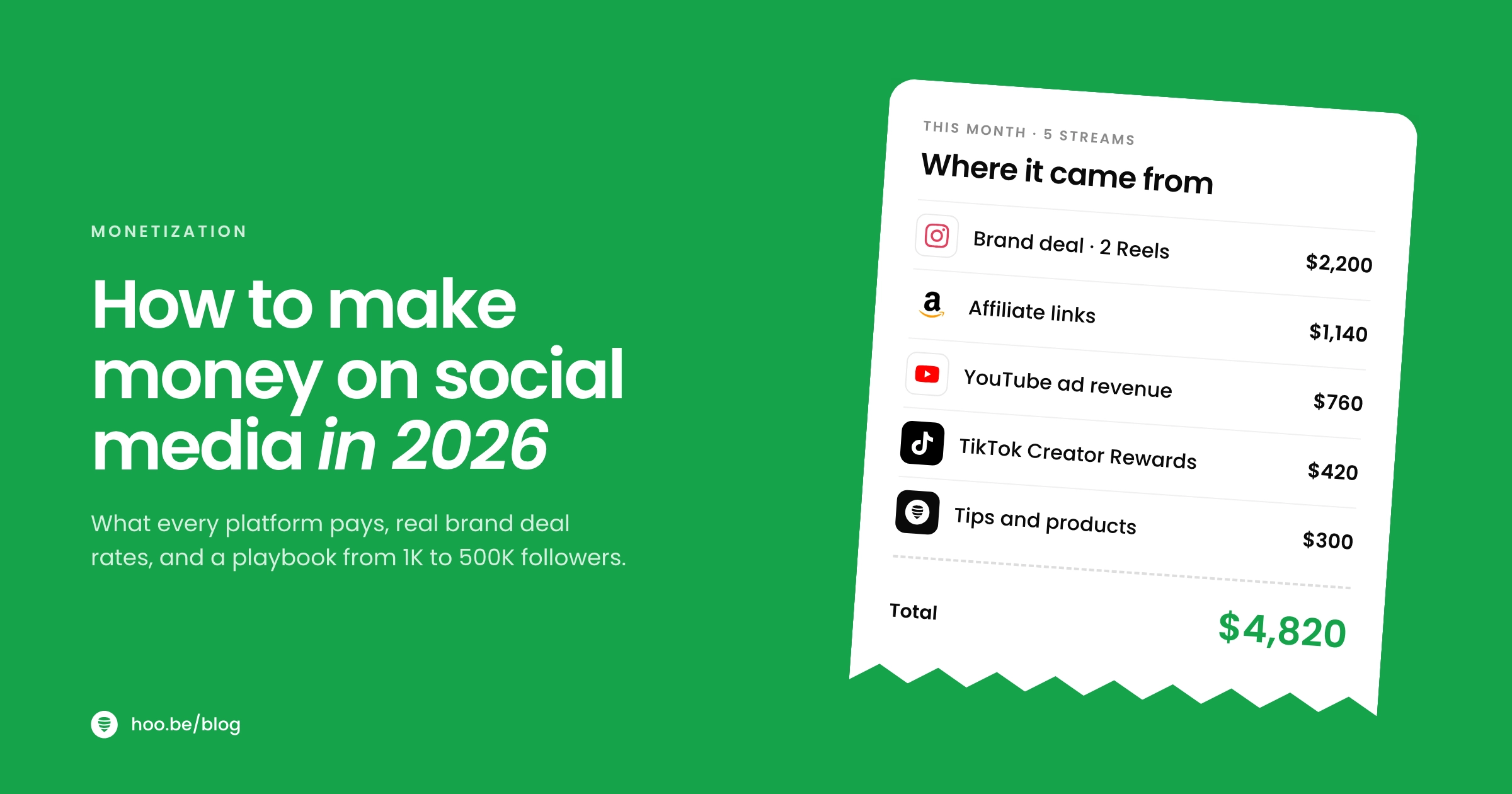
Platform payouts are passive once you qualify, but the per-view money is small and the rules change often. Treat them as a base layer. Our breakdown of how to make money on social media has every platform's 2026 rules in one table.
4. Paid memberships and subscriptions
Your most engaged followers pay a monthly fee for something extra: bonus episodes, behind the scenes, a private community, early access. It is the closest thing to a salary a creator can build, because it renews.
The split depends on where you host it. Patreon takes 10% of what you earn, plus payment processing, currency conversion and payout fees. TikTok subscriptions pay US and Canadian creators 70% after app store fees, with a performance bonus of up to 20% more, for a maximum of 90%. You need 10,000 followers and 100,000 video views in the past month to qualify. YouTube offers channel memberships to creators in its Partner Program.
Keep the offer simple. One tier with one clear benefit beats five tiers nobody can tell apart.
5. Coaching and consulting
If you have real expertise, whether that is fitness, money, content or a craft, paid calls turn it into income without making a product first. You do not need a big audience. A few hundred people who trust you on one topic can fill a calendar.

Price by outcome, not by the hour. "A 45-minute content audit with a written plan" is easier to buy than "an hour of my time." Collect a short intake form before each call so you spend the session on answers, not questions. A hoo.be Form block can ask for name, email, a link to their profile and a select field for what they need help with, and you can export the responses to CSV.
6. Your own products and merch
Merch, a physical product or your own branded line lets you keep the whole margin instead of a commission. It also takes the most work: design, samples, stock or print-on-demand, shipping and customer service. It works best as a fourth or fifth stream, once your community has shown it will buy what you recommend.
Test demand before you order stock. Share the design, take preorders or collect emails for a waitlist, and only produce what people asked for.

7. Tips and direct support
Some followers simply want to say thanks with money. A tip button catches them without asking them to commit to a monthly membership. It works especially well after a free resource, a useful tutorial or a live stream.
On hoo.be, the Tips block takes tips from $1 to $500, with default amounts of $5, $15 and $25, paid through Stripe. The hoo.be fee on tips is 9% on Free, 5% on Pro and 0% on Premium, and Stripe's processing of 2.9% + $0.30 applies separately.
How do you choose which income stream to start with?
Match the stream to what your audience already asks you for. A rough guide:
- They ask where you got things: start with affiliate links.
- They ask how you do things: start with a digital product or a guide.
- They ask for personal advice: start with coaching calls.
- They want more of you: start a membership.
- They want to support you: add a tip button.
Then add one stream at a time. Each new stream needs a launch, a place on your page and a few weeks of reminders before you can judge it.
How do you set up your link in bio to earn from every stream?
Every stream above ends with the same tap: a follower leaving the app to buy, book, tip or subscribe. That tap usually happens on your link in bio, so it should feel like a storefront, not a list of everything you have ever posted.
- Put your current money link first. Your newest product, this month's affiliate picks or your coaching offer goes at the top, above social links.
- Use the right block for each stream. On hoo.be that means a Product block for things you sell, a Carousel for a swipeable set of affiliate picks, a Tips block for support and a Form for coaching enquiries.
- Add an email signup. A Contact collection block turns a viral moment into an audience you keep. Our guide to building an email list from your link in bio covers what to offer.
- Add your tracking. Paste in your Facebook Pixel, TikTok Pixel or Google Analytics ID, and your Amazon affiliate tag, so every click is measured.
- Review every month. Check which links earn, cut the ones that do not, and move winners up. Our link in bio audit walks you through it.
Watch out
A page with 25 equal buttons converts worse than a page with five clear ones. If a stream has not earned anything in 60 days, move it down or take it off until you are ready to promote it properly.
How do you keep creator income stable?
Stability comes from three things: more than one stream, an audience you can reach without an algorithm, and knowing which links actually pay.
The audience part matters most. In Creator Spotlight's survey, creators who owned their audience, mainly through email, were 2.7 times more likely to earn $31,000 or more than creators who depended on platforms. An email list lets you launch a product, announce a membership or share a sale on your own schedule.
The measurement part is the easiest to skip. Look at clicks per link at least once a month. On hoo.be, the free plan shows 7-day and 30-day views, and Pro adds longer date ranges plus referrer, device and country breakdowns, so you can see which platform sends buyers rather than browsers.
What rules apply to affiliate links, tips and products?
In the US, the FTC says you must disclose any financial relationship with a brand, including affiliate commissions and free products, and put the disclosure where people will see it, not buried at the end of a caption. Words like "ad" and "sponsored" work; vague tags like "sp" or "collab" do not. Do not rely only on a platform's built-in label. Amazon also requires a specific line wherever you use its links: "As an Amazon Associate I earn from qualifying purchases."
All of this income is taxable. Keep a record of each payout, set aside part of every payment for tax, and talk to an accountant once your side income becomes steady.
Put every income stream on one page
hoo.be gives you Product, Tips, Carousel, Form and email signup blocks on one link in bio, with analytics that show which links earn. Plans start free; see hoo.be/pricing for the rest.
Create your hoo.beFrequently asked questions
How do content creators make money without brand deals?
The main options are affiliate links, digital products, platform payouts, paid memberships, coaching or consulting, your own products or merch, and tips. Most full-time creators combine two or three of these with occasional brand deals so their income does not depend on any single source.
What is the easiest income stream for a new creator?
Affiliate links. Amazon Associates does not publish a follower minimum, and you earn 1% to 10% on qualifying purchases depending on the category. You only need to link products you already recommend and disclose the relationship clearly.
How many income streams should a creator have?
Aim for at least three over time. Creator Spotlight found six-figure creators ran 3.3 income streams on average, compared with 2.2 for creators earning under $500. Add one stream at a time and give each a few weeks of promotion before you judge it.
How much does Patreon take from creators?
Patreon's platform fee is 10% of the income you earn on Patreon. Payment processing, currency conversion, payout fees and applicable taxes are charged on top, according to Patreon's pricing page.
How much do TikTok subscriptions pay creators?
Since October 1, 2025, creators in the US and Canada receive 70% of subscription revenue after app store fees, plus up to a 20% performance bonus, for a maximum of 90%. You need 10,000 followers and 100,000 video views in the past month.
Do I need a big audience to sell digital products or coaching?
No. What matters is trust on a specific topic. A small audience that keeps asking you the same question will often buy a guide or a call that answers it. Start with one offer and promote it consistently.
Can I accept tips on my link in bio?
Yes. On hoo.be, the Tips block accepts tips from $1 to $500 through Stripe. The hoo.be fee is 9% on Free, 5% on Pro and 0% on Premium, with Stripe's 2.9% + $0.30 processing fee applied separately.
Sources
- Influencer Marketing Hub, Creator Earnings Report (updated Jul 2026)
- Creator Spotlight, 2025 Creator Monetization Report (Dec 2025)
- Amazon Associates, standard commission income rates
- Amazon Associates Program Operating Agreement
- ShopMy for creators
- ShopMy Creator Guide, How payment works (Jul 2026)
- Gumroad pricing
- Patreon pricing
- Social Media Today, TikTok expands creator subscription payouts (Oct 2025)
- TikTok Newsroom, Introducing the Creator Rewards Program
- YouTube Help, YouTube Partner Program overview and eligibility
- FTC, Disclosures 101 for Social Media Influencers