In this article
- What is a personal brand, really?
- Why does a personal brand matter more in 2026?
- How do you build a personal brand, step by step?
- How do you find what you stand for?
- How do you write a personal brand statement?
- What makes a visual identity recognizable?
- How do you keep your brand consistent across platforms?
- How do you stay consistent without burning out?
- How do you know your personal brand is working?
- Frequently asked questions
To build a personal brand people remember, you need four things: a clear lane, a one-line brand statement, a look people recognize without reading your name, and the discipline to show up the same way for months. That is it. Talent and follower count matter less than most creators think. Clarity and repetition matter more.
The timing has never been better for creators who get this right. Edelman's 2026 Trust Barometer found that 7 in 10 people are hesitant or unwilling to trust people whose values differ from their own. That shift favors a creator with 12,000 followers and a clear point of view over a bigger account that could be anyone. At the same time, AI has made polished content cheap, so the one thing nobody can copy is you.
This guide walks through the full process: what a personal brand actually is, how to find your lane, how to write your brand statement, how to build a visual identity on a creator budget, and how to keep it consistent across every platform and your link in bio.
Key takeaways
- A personal brand is what people expect from you before they press play. It lives in their heads, not in your logo.
- Trust is shifting to smaller, values-aligned creators. 7 in 10 people hesitate to trust those whose values differ from theirs, according to Edelman.
- Originality is a loyalty driver: 33% of consumers name original content as a reason they stay loyal to a brand (Sprout Social, 2026).
- Write a one-sentence brand statement: who you help, with what, and what makes your take different. Use it everywhere.
- Consistency compounds. Buffer found creators who posted in 20 or more weeks out of 26 earned about 450% more engagement per post than sporadic posters.
What is a personal brand, really?
Your personal brand is the short answer someone gives when a friend asks, "Who is that?" It is the topic they connect with you, the tone they expect, and the reason they would recommend you. You do not own it outright. You shape it through every post, reply, thumbnail and bio.
That is why a personal brand is not the same as a logo, a color palette or a niche. Those are tools. The brand is the promise behind them: if you follow me, you will get this, in this way, every time. A creator who posts "budget home design for renters, with real prices" makes a promise people can repeat. A creator who posts "lifestyle content" does not.
A strong personal brand has three layers:
- Substance: the topic you are known for and the problem you solve.
- Point of view: the opinion or angle that makes your take different from the next account in the feed.
- Signals: the visual identity, formats, phrases and habits that make your content recognizable in under a second.
Why does a personal brand matter more in 2026?
Three shifts have made personal branding less optional and more practical, even for small creators.
Trust is moving to smaller, values-aligned voices
Edelman's 2026 research describes a world where people trust inside their own circle. In its brand-focused report, 4 in 10 people said unpaid voices have the biggest impact on whether they trust a brand, against 20% who pointed to the brand's own messaging. For a creator, that is an opening. People do not need you to be famous. They need to know what you stand for and feel that it matches what they care about.
AI made polish cheap, so identity is the differentiator
At the end of 2025, Instagram head Adam Mosseri wrote that "authenticity is becoming infinitely reproducible," meaning AI tools can now imitate the look of almost any content. Sprout Social's 2026 content strategy research points the same way: consumers say brands should make human-generated content their number one priority on social. When anyone can make a pretty video, the creator with a recognizable perspective, voice and story is the one people seek out.
Creators are turning their brand into a business
CreatorIQ's 2026 State of Creators survey of 5,095 creators found that 50% have launched, or plan to launch, their own brand. A product, a newsletter or a service only sells when the audience already knows what you stand for. Your personal brand is the foundation that every future offer sits on.
Edelman also measured what makes a brand feel relevant to people. The research is about company brands, but the same drivers map neatly onto creators: be useful, reflect who your audience is, and give them a community to belong to.
What makes a brand feel relevant
Notice what sits at the bottom. Jumping on every trend is the weakest driver of relevance. Being useful and reflecting your audience's identity are the strongest. That is a personal brand strategy in one chart.
How do you build a personal brand, step by step?
Here is the whole process in order. The sections below go deeper on each step.
- Pick your lane. Choose one topic you can talk about for a year without running out of ideas, and one audience you want to help.
- Find your point of view. Write down three opinions about your topic that most people in your niche would not say out loud.
- Write your brand statement. One sentence: who you help, with what, and how your approach is different.
- Set your visual identity. Two or three colors, one or two fonts, a consistent photo style and a profile photo that matches.
- Create one or two signature formats. A recurring series, intro line or layout that people learn to recognize.
- Make every profile say the same thing. Same name, handle, photo, bio line and link in bio across platforms.
- Show up on a schedule you can keep. Consistency beats volume. Pick a rhythm you can sustain for six months.
How do you find what you stand for?
Most creators skip this step and go straight to aesthetics. That is why so many feeds look nice and feel interchangeable. Start with substance.
Choose a lane you can sustain
A good lane sits where three things overlap: what you know or are learning, what you would happily talk about every week, and what a specific group of people is actively looking for. "Fitness" is a category. "Strength training for beginners over 40" is a lane. The narrower version is easier to remember and easier to recommend.
Add a point of view
Your point of view is what makes your content yours. It might be a belief ("you do not need a gym membership to get strong"), a constraint ("every recipe under $10"), or a lens ("home design for renters who cannot paint the walls"). Ask what you disagree with in your niche, and what you wish someone had told you earlier.
Name the person you are talking to
Picture one real type of person: their situation, their problem and what they have already tried. When you write for one person, your content gets specific, and specific content is what people share. In Edelman's research, 81% of people named "reflects my identity" as a reason a brand feels relevant. Your audience should see themselves in your work.

Pro tip
Read the last 50 comments and DMs you received. Write down every question and every compliment. The topics that come up again and again are what people already associate with you. That is your brand, showing itself.
How do you write a personal brand statement?
A personal brand statement is one sentence that sums up who you help and how. You will rarely publish it word for word, but it becomes the filter for your bio, your video intros, your pitch emails and your media kit.
Use this formula: I help [specific audience] [achieve a result or solve a problem] through [your approach or angle].
| Too vague | Memorable | Why it works |
|---|---|---|
| "Lifestyle and home content" | "I help renters make small apartments feel finished, with no tools and no paint." | A clear audience and a clear constraint |
| "Fitness motivation" | "I help beginners over 40 get strong at home in 30 minutes a day." | Specific age, setting and time |
| "Food and recipes" | "I help busy parents cook weeknight dinners for under $10 a plate." | A real problem with a number attached |
| "Business tips" | "I help freelancers price their work with confidence, using real quotes I have sent." | Proof built into the promise |
Test your statement with three questions. Could a stranger repeat it after hearing it once? Does it rule things out? Would your ideal follower say, "That is me"? If the answer to any of them is no, make it narrower.
What makes a visual identity recognizable?
The visual test is simple: if someone saw your post without your name on it, would they know it was yours? You do not need a designer to pass it. You need a few rules you never break.

Build a mini brand kit
- Colors: two or three, with one accent you use for highlights and text on thumbnails.
- Fonts: one for headlines, one for body text. Use the same ones on covers, thumbnails and your link in bio.
- Photo style: bright and airy, dark and moody, or flash and candid. Pick one and keep it.
- Profile photo: a clear, well-lit shot of your face. Use the exact same image on every platform so people recognize you instantly.
- Layout: a consistent cover or thumbnail template, so your grid and channel page look like a set.
Create signature formats
A recurring series with the same title card, a catchphrase you open with, a fixed camera angle or a recognizable editing rhythm all work as brand signals. If you need a system for turning one idea into several posts, see our guide on turning one content idea into a week of posts.
How do you keep your brand consistent across platforms?
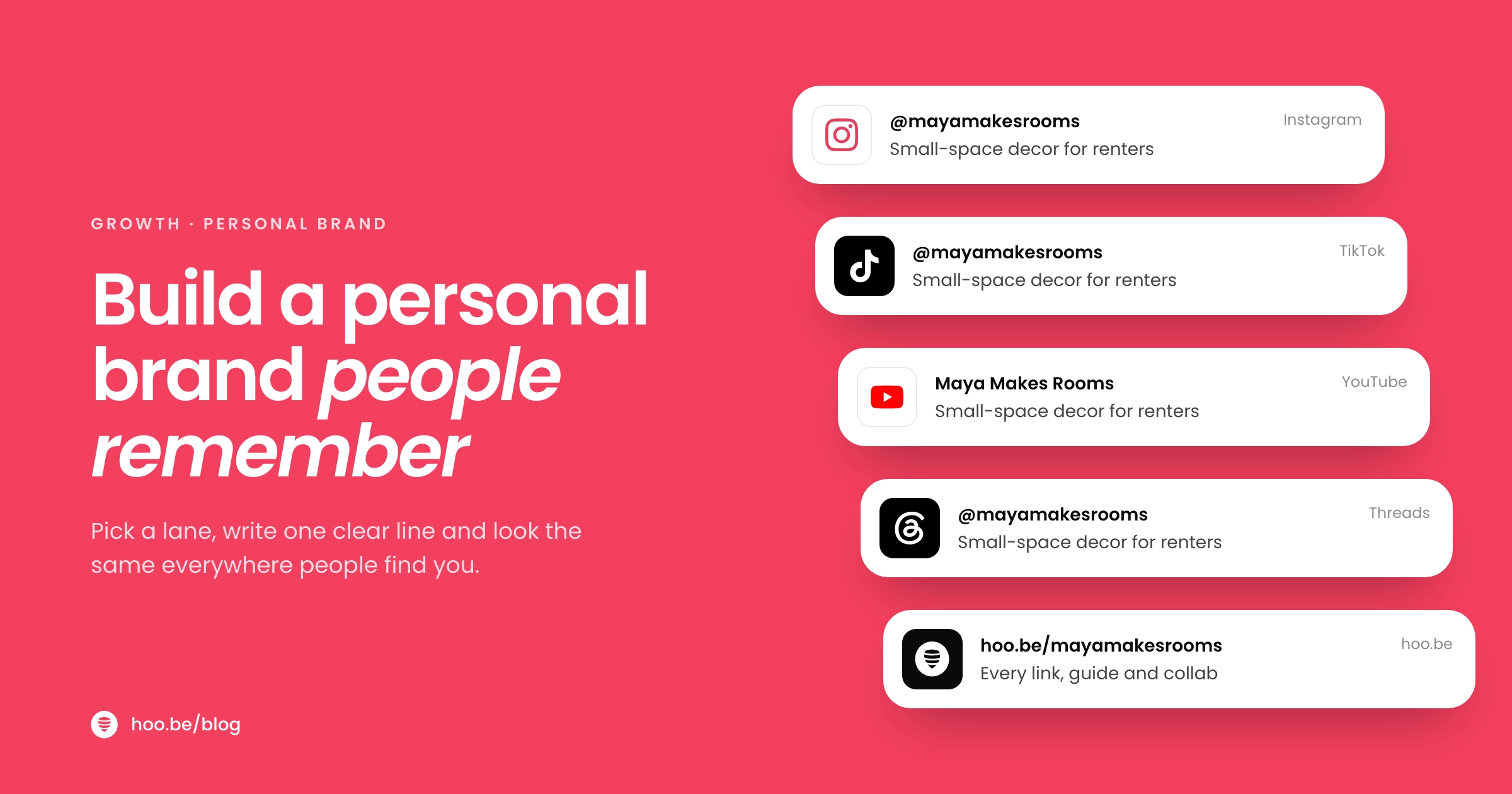
People will meet you in different places: a Reel shared in a group chat, a YouTube search result, a TikTok on the For You page. Each one should lead to the same person. Use the same name, the same handle where you can, the same profile photo and the same one-line bio everywhere.
| Platform | Where people judge your brand | What to keep identical |
|---|---|---|
 Instagram | Bio, grid, highlights, up to five profile links | Photo, bio line, cover style, primary link |
 TikTok | Bio, pinned videos, profile link | Photo, bio line, signature series |
 YouTube | Banner, thumbnails, channel description | Thumbnail template, colors, intro line |
 Threads | Bio, up to five profile links, written voice | Tone, opinions, bio line |
 LinkedIn | Headline, about section, featured links | Brand statement, photo |
Instagram has allowed up to five links in a bio since April 2023, and Threads added five profile links with click tracking in May 2025.
Make your link in bio the home of your brand
Your link in bio is the one place on social you fully control. Every platform above can send people there, so it should look and sound exactly like you: your photo, your colors, your brand statement in the header, and your best work first. A plain list of ten identical buttons tells visitors nothing. A page that leads with your signature series, your newsletter and your current offer tells them who you are in seconds.
Not sure what belongs on it? Start with our checklist of what to add to your link in bio. If you work with brands, you can also turn your link in bio into a creator portfolio.
Use the same words people search for
Consistency helps discovery too. If your brand statement says "small-apartment decor," use that phrase in your bios, captions, video titles and on-screen text. Search on social works on words, so repeating the phrase that describes you helps the right people find you. Our guide to social SEO for creators covers how.
How do you stay consistent without burning out?
A personal brand is built by repetition: the same tone, the same values, the same look, post after post. Buffer's 2026 analysis of more than 100,000 users across 26 weeks shows how much that repetition pays. Creators who posted in 20 or more of those weeks earned around 450% more engagement per post than sporadic posters. Those who posted in 5 to 19 weeks earned around 340% more.
The catch is that consistency is hard to keep up. In Patreon's State of Create research, 78% of creators said burnout affects their motivation, and 75% said platforms punish creators who do not post constantly. The answer is not to post more. It is to make your brand easier to produce.
- Choose a rhythm you can hold for six months. Three posts a week you never miss beats daily posts you abandon in March.
- Lean on your signature formats. A recurring series removes half the decisions from every post.
- Batch the work. Script, film and edit in blocks, then schedule.
- Reply to comments. It is the cheapest brand-building you can do. Buffer measured engagement lifts of around 21% on Instagram when creators reply.
A simple plan helps more than willpower. Read why every creator needs a content strategy for a framework you can set up in an afternoon.
How do you know your personal brand is working?
Followers are a lagging signal. These are the early ones:
- People describe you the way you describe yourself. Comments like "you are my go-to for renter-friendly decor" mean your statement is landing.
- The questions get more specific. When DMs move from "who are you?" to "which lamp was that?", people trust your judgment.
- Brands reach out for the right reasons. Inbound offers that match your lane show that your positioning is clear from the outside.
- Visitors find what they came for. Your link in bio analytics show which links people tap and where they come from. If your signature content gets the clicks, your brand and your page are aligned.
Once people know what you stand for, turning that trust into income becomes much easier. Our guides on building an audience that converts and landing your first brand deal pick up from here.
Give your personal brand a home
hoo.be turns your link in bio into a branded page built from blocks: your links, a swipeable carousel of your best work, embeds from Instagram, YouTube, TikTok and more, and a contact form for brand inquiries. Free to start, with Free, Pro and Premium plans.
Claim your hoo.beFrequently asked questions
What is a personal brand?
A personal brand is what people expect from you before they see your next post: the topic you are known for, your point of view and the way your content looks and sounds.
How do I start building a personal brand from scratch?
Pick one lane and one audience, write a one-sentence brand statement, set a simple visual identity, then make every profile match. After that, post on a schedule you can keep for at least six months. Consistency is what turns those choices into something people remember.
What is a good personal brand statement example?
A strong statement names an audience, a result and an angle, for example: "I help busy parents cook weeknight dinners for under $10 a plate." It is short enough to repeat after one hearing, and specific enough that the right person thinks, "That is me."
How long does it take to build a personal brand?
Expect months, not weeks. Buffer's 26-week study found creators who posted in 20 or more weeks earned around 450% more engagement per post than sporadic posters.
Do I need a niche to build a personal brand?
You need a clear lane to start, because a narrow focus is easier to remember and recommend. You can widen your topics later, once people associate you with something specific. Edelman's 2026 research shows trust is shifting to smaller, values-aligned creators, which rewards clarity.
Does AI make personal branding harder?
It makes polish less valuable and personality more valuable. Instagram head Adam Mosseri wrote that authenticity is becoming infinitely reproducible, and Sprout Social found consumers want brands to prioritize human-generated content. Your face, voice, opinions and story are the parts AI cannot replace.
Where should my personal brand live online?
On every platform you use, plus one page you control. Social profiles are rented space with limited room for links, so a branded link in bio page ties them together, shows your best work first and gives every platform the same place to send people.
Sources
- Yahoo Creators, The 2026 Edelman Trust Barometer reveals a major shift in the creator economy (Mar 2026)
- Adgully, Trust, not tribalism, will define brand growth in 2026: Edelman (Jun 2026)
- Sprout Social, The state of social media in 2026: Q3 pulse survey (Sep 2026)
- Sprout Social, The 2026 Social Media Content Strategy Report
- Newsweek, Instagram boss predicts future of app (Jan 2026)
- CreatorIQ, State of Creators Report 2026 (Aug 2026)
- Buffer, How to grow on social media in 2026: a data-backed guide (Jun 2026)
- Buffer, The State of Social Media Engagement in 2026 (Mar 2026)
- Patreon, State of Create
- TechCrunch, Instagram adds support for up to 5 links in bio (Apr 2023)
- TechCrunch, Threads now lets creators add up to 5 links to profiles (May 2025)