In this article
- What is social SEO, and why does it matter in 2026?
- What do people search for on social media?
- How does search work on TikTok, Instagram and YouTube?
- How do you find the keywords your audience searches for?
- Where should keywords go in a video or post?
- How many hashtags should you use in 2026?
- How do you show up on Google as a creator?
- How do you measure whether social SEO is working?
- Where should you send search traffic?
- Frequently asked questions
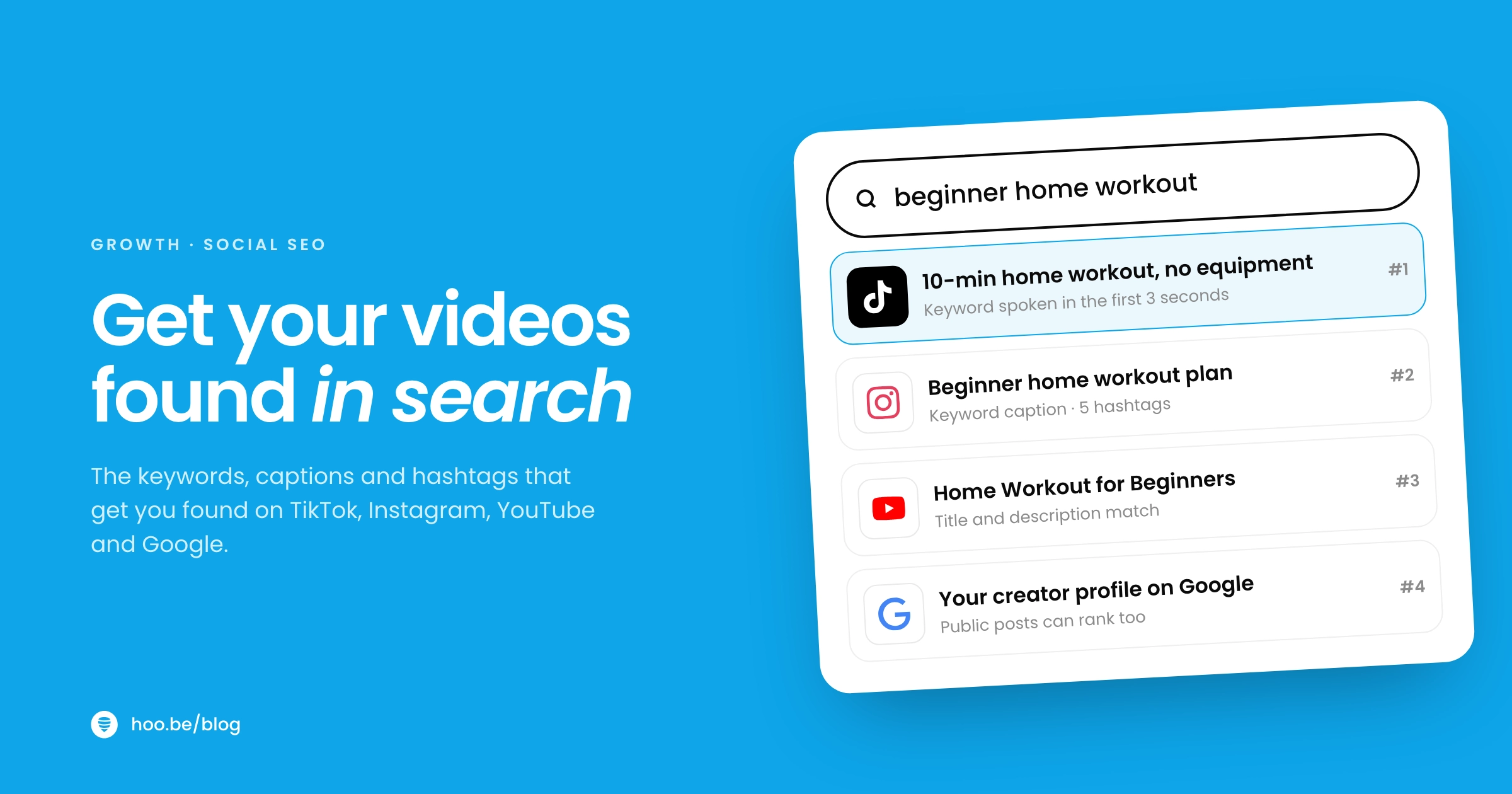
Social SEO means making your posts easy to find when people type a question into TikTok, Instagram, YouTube or Google. In 2026 it matters as much as the algorithm: Adobe found that 49% of US consumers now use TikTok as a search engine, up from 41% in 2024, and Instagram says its search uses your captions to understand what a post is about.
The good news is that social SEO is not technical. Every platform reads the same few signals: the words you say, the words on screen, your caption or title, and how people respond once they find you. Get those right and your videos keep getting found for months, long after the feed has moved on.
This guide covers how search works on each platform in 2026, how to find the phrases your audience actually types, where to put them, the new hashtag rules, how to show up on Google, and what to do with the traffic once it arrives.
Key takeaways
- Nearly half of US consumers search on TikTok. Tutorials and product reviews are what they look for most.
- Platforms read your spoken words, on-screen text, captions and titles. Say your main keyword out loud in the first few seconds.
- Instagram now allows a maximum of five hashtags per post. YouTube says tags play a minimal role in discovery.
- Public Instagram posts and YouTube videos can rank on Google, and Google Search profiles are open to creators with 10,000 followers on one platform.
- Search traffic is only useful if it has somewhere to go. Point it to a link in bio with a clear next step.
What is social SEO, and why does it matter in 2026?
Search engine optimisation used to mean Google. Now people search wherever they already spend time. They open TikTok to find a recipe, Instagram to find a hairdresser nearby, and YouTube to learn how to fix something. Social SEO is the practice of matching your content to those searches.
Search behaves differently from the feed. A feed post gets a burst of views and fades within days. A post that answers a common question keeps getting found every time someone asks it. That long tail is why social SEO compounds: every searchable post adds to a library that keeps sending you viewers.
It also brings better viewers. Someone who searched "beginner home workout no equipment" and found your video already wants exactly what you make. They are more likely to follow, save and tap your link than someone who scrolled past.
What do people search for on social media?
Adobe's 2026 survey of 807 US consumers asked what they look for when they use TikTok as a search engine. How-to content leads by a wide margin.
What people search for on TikTok
That tells you which formats to make searchable first. Tutorials, reviews and recommendations answer a specific question, so they match specific searches. A vlog titled "a day in my life" rarely does. If you make lifestyle content, give it a searchable angle: "what I eat in a day as a vegetarian runner" is something people type.
How does search work on TikTok, Instagram and YouTube?
Each platform publishes a little about how it ranks content. Here is what they say, in their own help centres and newsrooms.
| Platform | What it reads | What to do |
|---|---|---|
 TikTok | Your interactions plus video information such as captions, sounds and hashtags | Write a keyword-rich caption, say the keyword, add on-screen text |
 Instagram | Captions as reference data for search; up to five hashtags | Describe the post in plain words; pick five specific hashtags |
 YouTube | Relevance (title, tags, description, video content), engagement and quality | Put the search phrase in the title and first lines of the description |
 Google | Public Instagram posts, YouTube videos and creator profiles | Keep key posts public and claim a Google Search profile if eligible |
Sources: TikTok Newsroom, YouTube Help, Instagram via Social Media Today, Google for Creators. As of October 2026.
TikTok
TikTok says its recommendations weigh how you interact with videos, plus "video information" such as captions, sounds and hashtags, plus account settings like language and country. In April 2026, Social Media Today reported that TikTok had started showing creators the keywords it automatically attaches to their videos, based on popular searches, and letting them manage those keywords. If you see that option on a post, check that the keywords match what the video is really about.
Instagram
In August 2026, Instagram told creators that captions "tell search engines what your content is about" and that Instagram search uses captions as reference data for discovery. It recommended descriptive, relevant keywords. Since December 2025, Instagram limits reels and posts to five hashtags, saying fewer, targeted hashtags beat many generic ones. Instagram's Your Algorithm feature, which lets viewers choose topics across Feed, Reels and Explore, adds another reason to be clear about yours.
YouTube
YouTube is the most open about it. Its help centre says search ranks on three things: relevance (how well the title, tags, description and video content match the query), engagement (such as watch time for that query) and quality (signals of expertise, authority and trust). YouTube also says tags "play a minimal role" in discovery. Your title, thumbnail and description matter far more. For the full YouTube playbook, see how to get more views on YouTube.

How do you find the keywords your audience searches for?
You do not need a paid tool to start. The platforms tell you what people type.
- Use the search bar's autocomplete. Type the start of your topic into TikTok, Instagram and YouTube search and note every suggestion. These are real searches, ranked by popularity.
- Read your comments and DMs. Every question a follower asks is a search someone else is typing. "What foundation are you wearing?" becomes "best foundation for oily skin".
- Look at what ranks. Search your keyword and study the top results. If they are all three-minute tutorials, a 10-second clip will struggle.
- Get specific. "Skincare" is too broad to win. "Skincare routine for teenage acne" tells the platform and the viewer exactly what they will get.
- Use the same phrase everywhere. Pick one primary keyword per post, plus one or two close variations. Do not stuff in ten.
Pro tip
Keep a running list of keyword ideas in your notes app, grouped by topic. When you run out of ideas, you already have a list of questions people want answered. Our guide to creating content when you have no ideas shows how to turn that list into a content calendar.
Where should keywords go in a video or post?

Put your main keyword in every place a platform can read it. Here is the workflow to follow for each post.
- Say it in the first few seconds. Open with the exact phrase: "Here is a beginner home workout with no equipment." Platforms can transcribe speech, and viewers know straight away they are in the right place.
- Put it on screen. Add a text overlay with the keyword in your opening frame. It helps viewers who watch on mute and gives the platform another signal.
- Turn on captions. Auto-captions make your spoken words readable. Check them for errors on key terms and brand names.
- Write a descriptive caption or title. Lead with the keyword, then explain what the viewer will learn in a sentence or two. On YouTube, put it at the start of the title and in the first lines of the description.
- Add up to five specific hashtags. On Instagram that is now the limit. Choose tags that describe the topic, not generic ones like #fyp.
- Use a clear cover or thumbnail. A readable title on the cover helps people choose your result over the next one.
- Make a series. Post several videos on the same topic so the platform learns what you are about. Our guide to turning one idea into a week of posts makes this easy.
Optimise your profile too
Your profile is searchable as well. Use your display name field to add a short keyword next to your name if it fits, such as "Maya | Vegan Recipes". Write a bio that says plainly what you post and who it is for. Keep your username simple to spell. A memorable personal brand helps here too; see how to build a personal brand people remember.
How many hashtags should you use in 2026?
On Instagram, five at most, because that is now the limit on reels and posts. Instagram itself recommends using fewer, more targeted hashtags. On TikTok, hashtags are one piece of "video information" alongside your caption and sound, so three to five relevant ones is plenty. On YouTube, hashtags and tags matter least of all.
Think of hashtags as labels, not reach hacks. A good hashtag describes the topic of the post in the words a searcher would use. "#sourdoughforbeginners" helps. "#love" and "#explorepage" add nothing.
How do you show up on Google as a creator?

Social posts now rank in Google, which gives good content a second life.
- Instagram posts can appear in Google. Instagram's help centre says it allows search engines to index photos and videos from public reels and posts. In July 2025 Instagram expanded this to more regions for public accounts of people over 18, covering posts from January 1, 2020 onwards.
- Instagram may write the search title for you. In December 2025, Meta confirmed it had begun using AI to generate titles for posts that appear in search engine results. Clear captions give it better material to work with.
- YouTube videos rank in Google too, so the same title and description work pays off twice.
- Claim a Google Search profile. Google for Creators offers search profiles that gather your social accounts, websites and posts in one place, with a panel that can appear when people search your name. You need a public profile with at least 10,000 followers on one supported platform (Instagram, TikTok, YouTube or X). It is US-only for now.
Your link in bio can rank too. A page with your name, a clear description and links to your best work gives Google something to show when people search for you. On hoo.be, Pro plans include custom SEO settings for your page.
How do you measure whether social SEO is working?
Look for three signals over four to eight weeks, not one post at a time.
- Search as a traffic source. Platform analytics show where views come from. A growing share from search means your keywords are working.
- Views long after posting. Searchable posts keep getting views weeks later. Compare a keyword-led post with a trend-led one after 30 days.
- Profile visits and link taps. Search viewers who like what they find tap through. Track which posts lead to taps on your link in bio, and which links they tap.
When one post starts pulling search traffic, make more on the same topic and link them together in captions and playlists. Then audit your link in bio so the extra visitors find what they came for.
Where should you send search traffic?
Search brings people who want something specific. Give them the next step straight away. If a tutorial ranks, link the product list, the template or the full guide. If a review ranks, link the product. If people search your name, show them your best work and a way to stay in touch.
That last part matters most. Patreon's 2025 survey found 53% of creators say it is harder to reach their followers than it was five years ago. Search gets you discovered once; an email list lets you reach those people again. Here is how to build an email list from your link in bio.
Give your search traffic somewhere to land
hoo.be puts your links, products, embeds and an email signup form on one page, with analytics that show which links get tapped. Pro adds custom SEO plus referrer and country breakdowns. Free to start.
Claim your hoo.beFrequently asked questions
What is social SEO?
Social SEO is optimising your social media content so it appears when people search inside platforms like TikTok, Instagram and YouTube, and on Google. It means using the words your audience searches for in your spoken script, on-screen text, captions, titles and hashtags.
Do people really use TikTok as a search engine?
Yes. Adobe's 2026 survey found 49% of US consumers use TikTok as a search engine, up from 41% in 2024. The most common searches are video tutorials (61%), product reviews (45%), personal stories (41%) and influencer recommendations (33%).
How many hashtags should I use on Instagram?
Up to five. Since December 2025 Instagram has limited reels and posts to five hashtags, and it says fewer, more targeted hashtags work better than many generic ones. Choose hashtags that describe the specific topic of the post.
Do YouTube tags still matter?
Barely. YouTube's help centre says tags play a minimal role in discovery and are mainly useful for commonly misspelled terms. Your title, thumbnail and description matter much more, along with watch time for a given search.
Can Instagram posts show up on Google?
Yes. Instagram allows search engines to index photos and videos from public reels and posts. In July 2025 it expanded indexing to more regions for public accounts of adults, covering posts from 2020 onwards.
How do I get a Google Search profile as a creator?
Google for Creators lets you claim a search profile if you have a public profile with at least 10,000 followers on one supported platform: Instagram, TikTok, YouTube or X. It is available in the US first. You link your accounts to verify, then add your sites and pin posts.
How long does social SEO take to work?
Expect four to eight weeks before you see a clear trend. Search traffic builds as you publish more posts on the same topic. Track search as a traffic source and views after 30 days, rather than judging a single post on day one.
Sources
- Adobe Express, Using TikTok as a search engine (2026)
- Social Media Today, Almost half of US consumers use TikTok as a search engine (Mar 2026)
- Social Media Today on ESW's 2026 consumer research (Jul 2026)
- TikTok Newsroom, How TikTok recommends videos #ForYou
- Social Media Today, TikTok lets users manage keywords on videos (Apr 2026)
- Social Media Today, Instagram stresses the importance of captions (Aug 2026)
- Social Media Today, Instagram implements new limits on hashtag use (Dec 2025)
- Instagram, Control Your Instagram Algorithm (updated Jun 2026)
- YouTube Help, How YouTube search works
- YouTube Help, Add tags to your YouTube videos
- Social Media Today, Instagram expands Google access to public posts (Jul 2025)
- Social Media Today, Instagram is using AI to generate SEO titles for posts (Dec 2025)
- Google for Creators, Google Search profiles
- TechCrunch on Patreon's State of Create report (Feb 2025)