In this article
- What is a content strategy for creators?
- Why does every creator need a content strategy?
- How do you build a content strategy, step by step?
- How do you choose content pillars?
- How do you create a content calendar you will actually stick to?
- How often should you post, and in what format?
- How does a content strategy connect to your income?
- How should you use AI in your content strategy?
- How do you know if your content strategy is working?
- Frequently asked questions
Every creator needs a content strategy because posting without one burns your time on content that does not build toward anything. A content strategy is a simple plan that connects what you post to a goal: who it is for, which topics you return to, which formats you use, how often you publish, and where each post sends people next. It does not need to be long. One page is enough.
The data makes the case. Buffer's 2026 analysis of more than 100,000 users found creators who posted consistently earned around 450% more engagement per post than sporadic posters. Meanwhile, Patreon found 78% of creators say burnout affects their motivation. A strategy is how you get the first result without the second: fewer decisions, steadier output, and posts that add up.
This guide covers what a creator content strategy includes, what the 2026 data says about posting frequency and formats on each platform, how to choose content pillars, how to build a calendar you will actually follow, and how to tie it all to income.
Key takeaways
- A content strategy answers five questions: what is the goal, who is it for, what topics, which formats, and how often.
- Consistency is the biggest lever. Consistent posters saw around 450% more engagement per post than sporadic ones in Buffer's 26-week study.
- Formats behave differently by platform. On Instagram, carousels earned a 6.90% median engagement rate against 3.31% for Reels, but Reels reached 36% more people.
- Three to five content pillars keep you consistent without getting repetitive.
- Every post should point somewhere: a follow, a newsletter signup, a product or a brand deal. Your link in bio is where that happens.
What is a content strategy for creators?
A content strategy is the "why" behind your posts. A content calendar is the "when." Posting is the "what." Most creators have the last one, some have the second, and very few have the first. That is why so many accounts are busy but stuck.
A working creator content strategy fits on one page and includes:
- A goal: grow an email list, land brand deals, sell a product, or reach a monetization threshold. Pick one main goal per quarter.
- An audience: one specific type of person and the problem they want solved.
- Content pillars: three to five recurring topics you are known for.
- Formats: the post types you will use on each platform, such as Reels, carousels, long-form video or text posts.
- A cadence: how often you publish, set at a level you can keep for months.
- A next step: where each post sends people once they are interested.
- A review habit: a monthly check on what worked and what to change.
Why does every creator need a content strategy?
Because the platforms have changed what it takes to be seen, and a plan is the only way to keep up without burning out.
Reach is less predictable, so direction matters more
In Patreon's State of Create research, 53% of creators said reaching their followers is harder than it was five years ago, and 75% said platforms punish creators who do not post constantly. When reach is volatile, random posting gives you random results. A strategy gives you a body of work on a few clear topics, which is what both algorithms and people learn to recognize.
Consistency compounds, and a plan makes it possible
Buffer tracked more than 100,000 users over 26 weeks. Creators who posted in 20 or more of those weeks earned around 450% more engagement per post than sporadic posters, and those who posted in 5 to 19 weeks earned around 340% more. Buffer's engagement report adds a "no-post penalty": accounts that skipped a week grew more slowly than their own baseline.
Consistency is not willpower. It is the result of knowing what you will post next before you sit down to make it.
It protects you from burnout
78% of creators in Patreon's survey said burnout affects their motivation, and 56% said the algorithm has discouraged them from exploring their passions. A strategy reduces the daily "what do I post?" decision to a slot in a calendar, and gives you permission to ignore trends that do not fit your pillars.
It connects content to income
A viral post with no next step is a spike that disappears. A strategy decides in advance what each post is working toward, so a good week turns into email subscribers, product sales or a stronger media kit instead of just a nice number.
How do you build a content strategy, step by step?
You can set up the first version in an afternoon. Then improve it once a month.
- Set one goal for the next 90 days. Make it measurable: "500 newsletter subscribers," "three paid brand deals," or "$1,000 in affiliate sales."
- Define your audience in one sentence. Who they are, what they want, and what they have already tried.
- Choose three to five content pillars. Topics that serve your audience and connect to your goal.
- Pick one primary platform and one or two formats. Master one channel before spreading thin. Repurpose to others later.
- Set a cadence you can keep for six months. Start below your maximum. You can always add more.
- Build a simple content calendar. Assign pillars to days, and plan launches, brand deals and seasonal moments in advance.
- Give every post a next step. Follow for the series, comment a keyword, or tap the link in bio. Update your link in bio to match what you are promoting.
- Review monthly. Keep what moves your goal, cut what does not, and adjust one thing at a time.
How do you choose content pillars?
Content pillars are the three to five recurring topics that make up most of your posts. They keep you consistent, make planning faster and teach your audience what to expect. Good pillars sit at the overlap of what your audience wants, what you can talk about for a year, and what supports your goal.
Here is how that might look for a hypothetical home-cooking creator whose goal is to grow a newsletter and sell a recipe ebook:
| Pillar | Example posts | Job it does |
|---|---|---|
| Teach | "3 weeknight dinners under $10," knife skills in 60 seconds | Earns saves and shares, attracts new followers |
| Show | Weekly grocery haul, what I cooked this week | Builds familiarity and trust |
| Opinion | Overrated kitchen gadgets, myths I stopped believing | Shows your point of view, sparks comments |
| Community | Cooking your requests, replying to comments with a video | Deepens connection with existing followers |
| Offer | Free meal plan for subscribers, the ebook, favorite tools | Turns attention into signups and sales |
Most of your posts should come from the first four pillars. The "offer" pillar works best when it is woven in naturally and regularly, not saved for an awkward hard sell once a quarter.
Pro tip
Turn each pillar into a named series with a recurring title or opening line. Series are easier to plan, easier to batch, and they double as brand signals people remember. Our guide on building a personal brand people remember explains why.
How do you create a content calendar you will actually stick to?

The best calendar is the one you use. A notes app, a spreadsheet or a paper planner all work. What matters is the structure:
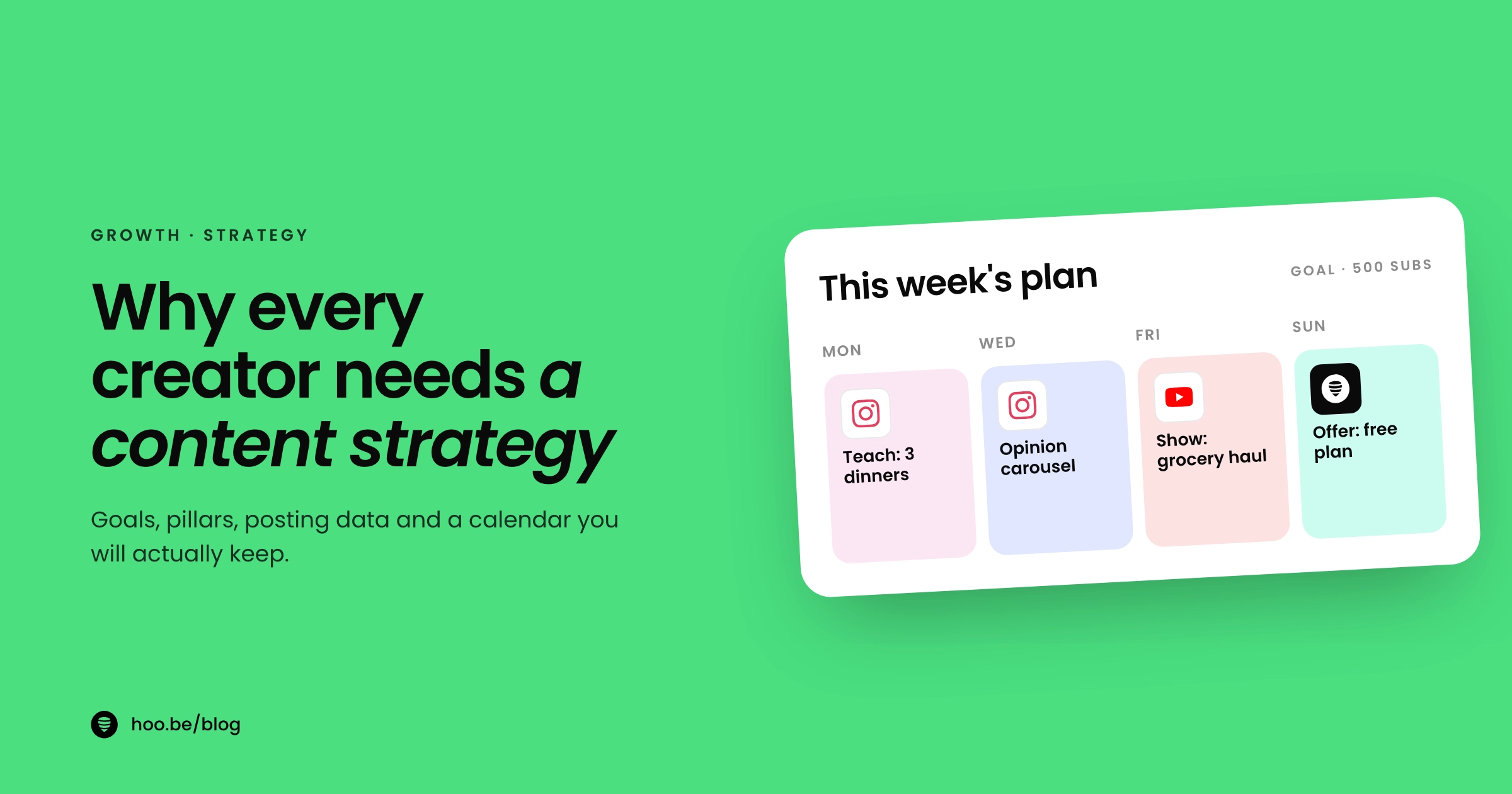
- Theme your days. For example, Monday is Teach, Wednesday is Opinion, Friday is Show. You never start from a blank page.
- Plan in monthly blocks, fill in weekly. Map launches, brand deliverables and seasonal dates a month ahead, then pick specific topics each week.
- Batch production. Script on one day, film on another, edit on a third. Switching tasks less often saves hours.
- Repurpose on purpose. One strong idea can become a Reel, a carousel, a newsletter section and a long-form video. Our guide to turning one content idea into a week of posts shows the method.
- Keep an idea bank. Save comments, DMs and questions as future posts. If you are stuck, try these prompts for creating content when you have no ideas.
How often should you post, and in what format?
There is no universal number, but there is good 2026 data. Buffer analyzed more than 52 million posts across 10 platforms for its engagement report, plus 100,000+ users for its growth playbook. Here is what it found on each major platform.
| Platform | Posting frequency that drove growth | What the format data shows |
|---|---|---|
 Instagram | 3 to 5 posts a week for real growth, 6 to 9 for faster follower growth | Carousels 6.90% median engagement vs Reels 3.31%, but Reels get 36% more reach |
 TikTok | 2 to 5 posts a week showed strong view gains, 6 to 10 performed better | Median engagement around 4.6% |
 LinkedIn | 2 to 5 posts a week for the highest gains | Carousels 21.77% vs video 7.35% |
 Threads | 1 to 3 or more posts a day | Video 5.55% vs text 2.79% |
 Facebook | 1 to 2 posts a day | Small gaps: images 5.20%, video 4.84%, text 4.76% |
 X | 3 to 5 posts a day | Text 3.56% beats video 2.96% |
 Pinterest | Not reported | Video 5.75% vs images 3.15% |
Source: Buffer, State of Social Media Engagement 2026 (52M+ posts) and Buffer's 2026 creator growth guide. Facebook frequency comes from a HubSpot study cited by Buffer. Engagement rates are medians.
Two lessons stand out. First, the right format depends on your goal: on Instagram, Reels are better for reach and new followers, while carousels earn more engagement from people who see them. A strategy that mixes both does both jobs. Second, Buffer found that reach per post tends to fall as frequency rises, even as total growth goes up. More posts help in aggregate, but only if quality holds.
Median engagement rate by platform, 2025
Engagement rate is not the only thing that matters. A platform with lower engagement might still be where your audience searches, buys or watches long videos. If YouTube is your main channel, our guide on getting more views on YouTube covers its specific playbook, and social SEO for creators explains how to make each post findable in search.
Post original work
Whatever your cadence, make it original. Instagram has said it makes Reels that were already posted on Instagram less visible, along with Reels that carry watermarks from other apps. Repurposing your own ideas is smart. Reposting other people's content, or exporting with another app's watermark, works against you.
How does a content strategy connect to your income?
Every pillar and every post should ladder up to your 90-day goal. Here is how the same strategy changes depending on what you are working toward.
- Goal: brand deals. Show your niche clearly, post content in the formats brands buy (Reels, Shorts, TikToks), and keep a portfolio of your best work one tap away. Our guide on landing your first brand deal covers the pitch.
- Goal: email list. Create posts that tease a free resource, and make the signup the first thing on your link in bio. See how to build an email list from your link in bio.
- Goal: product sales. Use the Teach and Show pillars to demonstrate the problem your product solves, then point to it consistently.
- Goal: affiliate income. Plan recurring "what I use" content and keep your recommended products organized and current.
The handoff from content to income almost always happens in your link in bio. If your strategy changes every month but your link in bio still shows last season's links, you lose the people your content worked hardest to win. Update it every time your focus changes, and check it with our link in bio audit.

How should you use AI in your content strategy?
Most creators already do. Kit's 2026 survey of 550 creators found 71.7% use AI at least weekly, most often for brainstorming (82.7%) and writing or editing (82.7%). The same survey found 89.2% always review and edit AI output before using it.
That balance is the right one. Sprout Social's 2026 content strategy research found consumers want brands to make human-generated content their top priority on social, and Instagram head Adam Mosseri has warned that AI is making authenticity "infinitely reproducible." When polish is easy to fake, your perspective is the part that stands out. Use AI to brainstorm hooks, outline scripts, summarize comments and repurpose content. Keep the ideas, opinions, stories and on-camera presence yours.
How do you know if your content strategy is working?
Measure against your goal, not against vanity metrics. Once a month, look at:
- Goal progress: subscribers, sales, deals or followers gained against your 90-day target.
- Pillar performance: which pillars earn saves, shares and comments, and which drive clicks.
- Format performance: reach versus engagement for each format on each platform.
- Link in bio clicks: which links people tap after your posts, and which platforms send the most visitors.
- Consistency: did you hit your planned cadence? If not, lower it rather than abandoning the plan.
Also look at conversations. Buffer found replying to comments lifted engagement by around 21% on Instagram, 30% on LinkedIn and up to 42% on Threads. Comments are both a signal and a source of your next ideas. When the review is done, change one or two things and run the next month.
Make your link in bio keep up with your strategy
hoo.be lets you rebuild your page around what you are promoting this month: links, carousels, a newsletter signup form, products and embeds of your latest posts. Pro adds page scheduling and advanced analytics, so you can plan ahead and see which links earn.
Claim your hoo.beFrequently asked questions
What is a content strategy for creators?
A content strategy is a plan that connects what you post to a goal. It defines your audience, three to five content pillars, the formats you use on each platform, how often you post, and where each post sends people next, such as a newsletter, product or link in bio.
Why is a content strategy important for creators?
It makes consistency possible and gives your posts direction. Buffer found creators who posted consistently earned around 450% more engagement per post than sporadic posters, and a plan reduces the daily decisions that contribute to burnout, which 78% of creators report in Patreon's research.
What is the difference between a content strategy and a content calendar?
A content strategy decides why and what you post: your goal, audience, pillars and formats. A content calendar decides when: which post goes out on which day. You need the strategy first, otherwise the calendar is just a schedule of random posts.
How many content pillars should a creator have?
Three to five is the sweet spot. Fewer feels repetitive and more makes your account hard to describe. A useful mix covers teaching, showing your process or life, sharing opinions, building community and, regularly, your offer.
How often should creators post in 2026?
Buffer's 2026 data suggests three to five posts a week on Instagram, two to five on TikTok and LinkedIn, and one or more a day on Threads and X. The most important rule is to choose a cadence you can sustain, because skipping weeks slows growth.
Should I use AI to plan my content?
Yes, for brainstorming, outlining and repurposing. Kit found 71.7% of creators use AI weekly and 89.2% always edit its output. Keep the ideas, stories and opinions your own, since consumers say human-generated content should be brands' top priority on social.
Sources
- Buffer, How to grow on social media in 2026: a data-backed guide (Jun 2026)
- Buffer, The State of Social Media Engagement in 2026: 52M+ posts analyzed (Mar 2026)
- Patreon, State of Create
- TechCrunch, For You feeds are not for creators, Patreon says (Feb 2025)
- Kit, The State of AI in the Creator Economy (2026 survey) (Aug 2026)
- Sprout Social, The 2026 Social Media Content Strategy Report
- Newsweek, Instagram boss predicts future of app (Jan 2026)
- Instagram, Instagram ranking explained