In this article
- Why should your link in bio double as a creator portfolio?
- What do brands look for in a creator portfolio in 2026?
- What should a creator portfolio include?
- How do you turn your link in bio into a portfolio, step by step?
- How do you show results without breaking a brand's confidentiality?
- Portfolio, media kit or website: which do you need?
- Where do brands find creators in 2026?
- What should a portfolio look like for different types of creators?
- How do you keep your creator portfolio current?
- Frequently asked questions
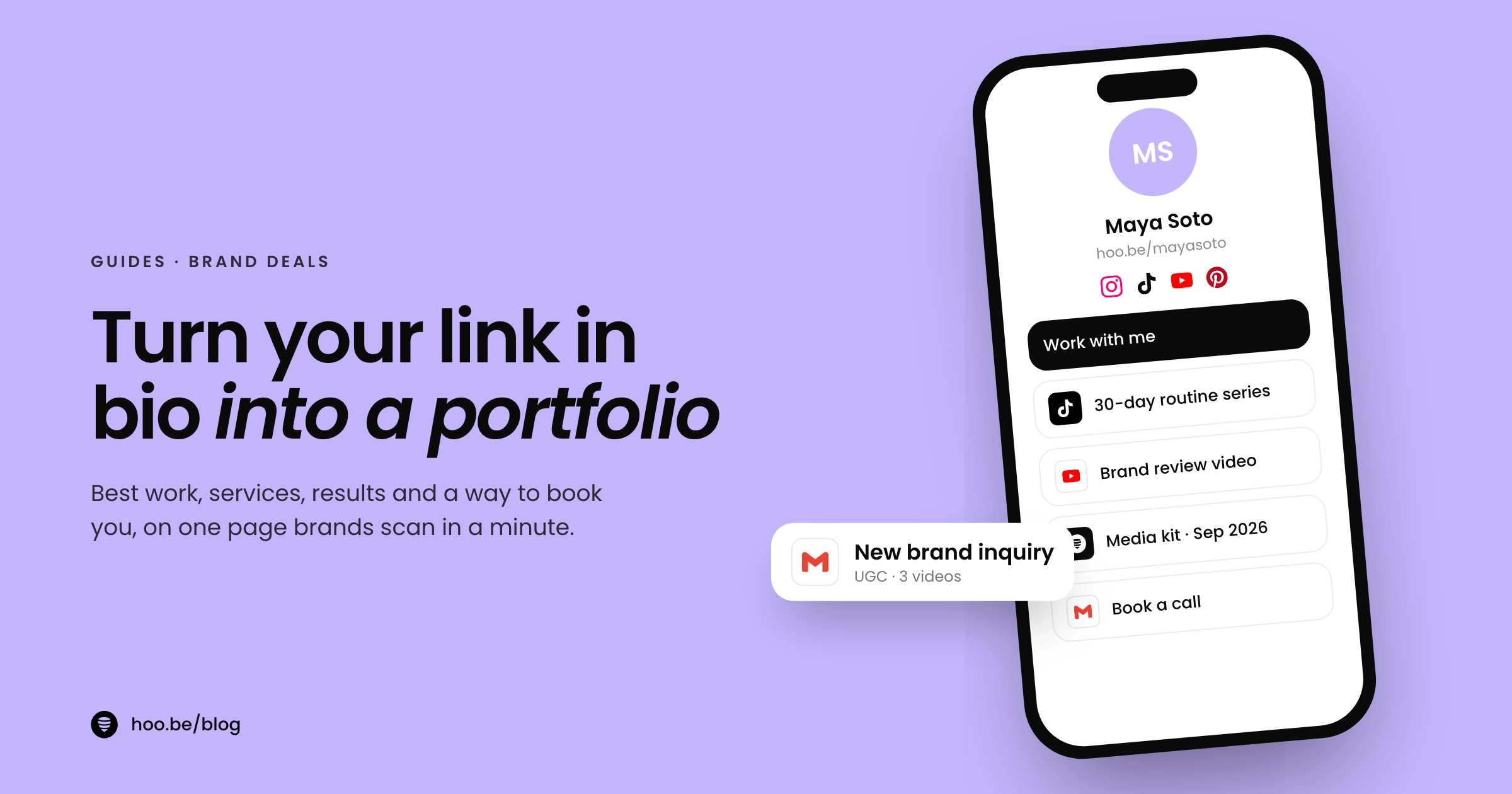
To turn your link in bio into a creator portfolio, put five things on it in this order: one line on who you make content for, your three to six best pieces of work, the services you offer, proof that your content performs, and a one-tap way for brands to reach you. Keep it short enough that a brand manager can understand what you do in under a minute, without waiting for a reply to a DM.
It matters more in 2026 than it used to. Brands are finding creators through search tools, marketplaces and AI, not only through your follower count. In CreatorIQ's 2026 State of Creators research, brands ranked creator suitability first and content performance second when choosing partners, and placed follower count last of eight factors. Your portfolio is where you show both.
This guide covers what brands look for, what to include, how to build it step by step, and how to keep it current without turning your page into an archive.
Key takeaways
- Brands say fit and content performance matter most. Your portfolio should prove both in the first screen.
- Lead with a one-line positioning statement, then three to six of your best pieces. Curate, do not archive.
- Show results brands care about: views, engagement, saves, clicks and promo code uses, with dates.
- Make contact effortless: a business email or an inquiry form with the questions you would ask anyway.
- Update after every strong project. A portfolio that shows this month's work signals you are active and booked.
Why should your link in bio double as a creator portfolio?
Because it is the one place every interested brand already looks. When a marketer finds you through a post, a search or a creator marketplace, the next tap is almost always your profile and then your bio link. If that page answers their questions, you are on the shortlist. If it is a list of socials and an old discount code, they move on to the next creator.
Discovery is also becoming more structured. In February 2026 Meta expanded its Creator Marketplace beyond the 19 countries where it had been available, and started highlighting creators who have tagged a brand in their content or said they are interested in working with it. In September 2026 it launched the Creator Marketing Hub, which puts discovery filters, keyword search, organic insights and partnership messaging in one place for brands. On TikTok One, brands set up a profile and projects, and creators are invited, apply or submit ad creative.
Those tools get you seen. Your portfolio is what closes the gap between "this creator showed up in a search" and "let's send an offer".

What do brands look for in a creator portfolio in 2026?
The research points in one direction: fit and proof beat size.
Smaller creators are in demand, too. In Influencer Marketing Hub's 2026 benchmark of more than 600 marketers, about half plan to expand work with nano, micro and UGC creators, while only about one in five plan to expand with macro creators.
Brands planning to expand work with each creator type in 2026
One honest caveat. The same CreatorIQ study found that follower count is still the strongest predictor of what creators earn on Instagram, YouTube and TikTok, even though brands say it matters least. A strong portfolio does not erase that gap, but it is how a smaller creator gets the first deal and then argues for a higher rate on the second.
In practice, brands are scanning your page for answers to five questions:
- Who is your audience? Niche, location, age range and what they come to you for.
- What does your work look like? Real examples in the formats they want to buy.
- Does it perform? Numbers with dates, not adjectives.
- Are you easy to work with? Clear services, turnaround and a professional way to get in touch.
- Is it safe for our brand? Consistent tone, proper disclosures, nothing off-brand at the top of the page.
What should a creator portfolio include?
Seven sections cover everything a brand needs. Here is what goes in each, and which hoo.be block handles it if you build on hoo.be.
| Section | What to show | Block to use |
|---|---|---|
| 1. Positioning line | One sentence: who you make content for and what about. "Budget skincare for sensitive skin, for women 25 to 34." | Profile bio and a Title block |
| 2. Featured work | Three to six of your strongest pieces, ideally including at least one branded example | Instagram, TikTok and YouTube embeds, or a Carousel |
| 3. Services | What you offer: sponsored posts, UGC videos, usage rights, events, speaking | Title block plus Link blocks |
| 4. Results | Dated metrics from past work: views, saves, clicks, code uses, sales where you can share them | Link to a case study or your media kit |
| 5. Audience snapshot | Top countries, age range and platform split, with the date you pulled them | Link to your media kit |
| 6. Brands you've worked with | Names or a short list, only where you have permission | Title block or Carousel |
| 7. Contact | A business email and an inquiry form | Contact collection or a Form block |
If you do not have a media kit yet, build one alongside your portfolio. Our creator media kit guide covers what goes in it and how to keep the numbers current.
Choosing your featured work
Pick pieces that match the deals you want next, not just your most viral posts. If you want skincare partnerships, a 2 million view comedy sketch is less useful than a 40,000 view routine video with high saves and a clear product moment. Include a mix of formats if you sell more than one: a short vertical video, a longer video, a photo carousel, and a raw UGC-style clip for brands that run ads.

How do you turn your link in bio into a portfolio, step by step?
You can do this in an afternoon. Work through the steps in order, because each one feeds the next.
- Write your positioning line. One sentence that names your audience and your topic. Put it in your bio and at the top of the page.
- Pick three to six pieces of work. Choose for relevance to the brands you want, then for performance. Embed them so brands can watch without leaving your page.
- List your services. Name each deliverable clearly. Add "rates on request" or a starting price, whichever you are comfortable with.
- Add proof. For each featured piece, note one or two results with the date. Link to a longer case study or media kit for the full picture.
- Set up an inquiry path. Add a business email and a short form that asks for brand name, product, deliverables, timing and budget range.
- Clean up everything else. Move personal links, old videos and expired campaigns below the portfolio or remove them.
- Test it like a brand would. Open the page on your phone, give yourself 60 seconds, and check you can answer the five questions above.
Pro tip
Ask the questions you would ask on a call in your inquiry form: brand, product, deliverables, timeline and budget range. You will spend less time on back-and-forth emails, and the brands that fill it in are already serious. When you reply, our brand email templates work for responses as well as pitches.
How do you show results without breaking a brand's confidentiality?
Many brand contracts limit what you can share. You can still show proof without breaching them:
- Ask before you publish. When a campaign wraps, ask the brand whether you can name them and share results. Many will say yes to public metrics.
- Share your side of the numbers. Views, reach, saves, shares and link clicks from your own analytics are usually yours to report.
- Use ranges and percentages. "Top 10% of my posts that quarter" or "2.4x my average saves" proves performance without exposing sales data.
- Anonymize when needed. "A national skincare brand" still tells the next brand what kind of work you do.
- Date everything. A number without a date looks stale even when it is not.
Brands measure campaigns in concrete ways. Influencer Marketing Hub found promo codes (45.9%), affiliate links (26.0%) and native shop features (25.0%) are the most common tracking methods, and brand awareness is the most selected KPI (55.1%). If you can show code uses or link clicks from past work, lead with them.
Keep sponsored work disclosed
When you feature paid work in your portfolio, the original posts should already carry a clear disclosure. The FTC says disclosures belong with the endorsement itself, and one that appears only on a profile page is likely to be missed. Brands checking your portfolio will notice either way. See the FTC's Disclosures 101.
Portfolio, media kit or website: which do you need?
They overlap, but each does a different job. Most working creators end up with a portfolio page and a media kit, and only add a full website later.
| Link in bio portfolio | Media kit | Personal website | |
|---|---|---|---|
| Main job | First impression for anyone who taps your bio | Detailed proof for a brand already interested | Long-form home for your brand, blog or shop |
| Format | Mobile page with embeds and links | PDF or web page with stats and rates | Multi-page site |
| Update cadence | After every strong project | Monthly or quarterly | As needed |
| Setup time | An afternoon | A day | Days to weeks |
| Best for | Every creator | Creators pitching or being pitched | Creators with products, services or press |
If you are weighing a separate page for one offer, our link in bio vs. landing page comparison walks through when each makes sense.
Where do brands find creators in 2026?
Your portfolio needs to work no matter which door a brand comes through. Here are the main discovery paths and what each means for your page.
| Where | How it works | What it means for your portfolio |
|---|---|---|
 Instagram and  Facebook | Meta's Creator Marketing Hub gives brands discovery filters, keyword search and organic insights, and highlights creators who have tagged their brand | Use the same niche keywords in your bio and portfolio, and tag brands you genuinely use |
 TikTok | On TikTok One, brands post projects; creators are invited, apply or submit ad creative | Keep UGC-style samples on your page for brands that review applications |
 Search and AI tools | Creator discovery is marketers' most common use of AI (36.7%) | A clear page title, description and positioning line help any tool understand what you do |
| Your own outreach | You pitch the brand directly | Your portfolio link is the proof in every pitch email |
Sources: Social Media Today on Meta's Creator Marketplace updates (Feb 2026) and Creator Marketing Hub (Sep 2026), TikTok Ads Help Center, Influencer Marketing Hub 2026. As of October 2026.
What should a portfolio look like for different types of creators?
The structure stays the same. What you feature first changes with the work you sell.

UGC creators
Your audience size does not matter much; your samples do. Lead with three to five short product videos in different styles (unboxing, demo, testimonial, before and after), then list your deliverables and usage options. Our guides to UGC rates and your first 30 days as a UGC creator go deeper.
Lifestyle, beauty and fashion creators
Lead with one branded example and two organic posts that show your style. Add an audience snapshot near the top, since brands in these categories often filter by age and location. Shoppable links to products you already recommend show you can drive action, not just views.
Musicians, podcasters and educators
Lead with your best release, episode or lesson, embedded so it plays on the page. Then list partnership formats you offer, such as host reads, live events or sponsored segments, and add upcoming dates if you perform or speak.
Photographers and editors
Treat the page as a contents page: a carousel of your strongest shoots, a clear list of services, and links out to full galleries. Brands that hire you for production care about range and turnaround, so state both.
How do you keep your creator portfolio current?
A portfolio is never finished. A light routine keeps it useful:
- After every strong project: swap in the new piece if it beats your weakest featured item, and add one dated result.
- Monthly: refresh audience numbers, check every link and embed still works, and remove anything expired.
- Quarterly: reread your positioning line. If the deals you want have shifted, change what you feature first.
Keep it focused. Brands will not scroll through two years of content, so think of the page as an introduction, not an archive. For a broader look at standing out, see how to build a personal brand people remember.
Building your portfolio on hoo.be
hoo.be pages are built from blocks, which maps neatly onto the seven sections above. Embeds for Instagram, YouTube (including Shorts), TikTok, X, Vimeo, Loom and Spotify let brands watch or listen without leaving your page. Carousel blocks hold a swipeable set of work, Title blocks label each section, and Contact collection and Forms (with text, email, select and yes/no fields) give brands a structured way to reach you. Contacts and responses export to CSV.
On Pro you can set custom SEO for the page and see referrer, device and country breakdowns in analytics. Premium adds custom domains, a verification checkmark and access to CreatorPass brand-campaign applications. See hoo.be/pricing for current plans.
Make your link in bio your portfolio
Embed your best work, list your services and add an inquiry form on one hoo.be page that brands can scan in a minute. Start on the Free plan.
Build your hoo.be pageFrequently asked questions
What should a creator portfolio include?
A one-line positioning statement, three to six of your best pieces of work, the services you offer, dated results from past projects, an audience snapshot, brands you have worked with (with permission) and a clear way to contact you, such as a business email or inquiry form.
Can my link in bio be my creator portfolio?
Yes. A link in bio page is where brands already land after finding your profile, so it works well as a lightweight portfolio. Put your positioning line and best work at the top, and move personal or outdated links lower down.
How many examples should I put in my portfolio?
Three to six is enough for most creators. Choose pieces that match the brand deals you want next and show the formats you sell, then link to a media kit or case study for anyone who wants more.
Do I need a portfolio if I have a media kit?
They do different jobs. A portfolio page is the first impression for anyone who taps your bio, while a media kit gives an interested brand detailed stats and rates. Most working creators keep both and link the media kit from the portfolio.
Can I show brand work in my portfolio if I signed an NDA?
Only what your contract allows. Ask the brand when the campaign ends, share metrics from your own analytics, use percentages or ranges instead of sales figures, and anonymize the brand if needed.
What do brands look for when choosing creators in 2026?
In CreatorIQ's 2026 research, brands ranked creator suitability first and content performance second, with follower count last of eight factors. Brands also lean toward smaller creators: about half of marketers in Influencer Marketing Hub's 2026 benchmark plan to expand work with nano, micro and UGC creators.
How often should I update my creator portfolio?
Swap in new work after every strong project, refresh numbers and check links monthly, and revisit your positioning every quarter. Dated, recent examples signal to brands that you are active.
Sources
- CreatorIQ, State of Creators Report 2026 (Aug 2026)
- Marketing Dive, Creator fit beats follower count for brands (Aug 2026)
- Influencer Marketing Hub, Influencer Marketing Benchmark Report 2026 (May 2026)
- Social Media Today, Meta announces discovery improvements for Creator Marketplace (Feb 2026)
- Social Media Today, Meta adds more creator partnership tools (Sep 2026)
- TikTok Ads Help Center, How to set up your TikTok One brand profile
- FTC, Disclosures 101 for Social Media Influencers