In this article
- What is the difference between a link in bio and a landing page?
- What is a link in bio page built for?
- What is a landing page built for?
- Which converts better, a link in bio page or a landing page?
- When should you use a link in bio page?
- When should you use a landing page?
- Can you use a link in bio page and a landing page together?
- How do you make a link in bio page convert better?
- How does hoo.be handle both?
- Frequently asked questions
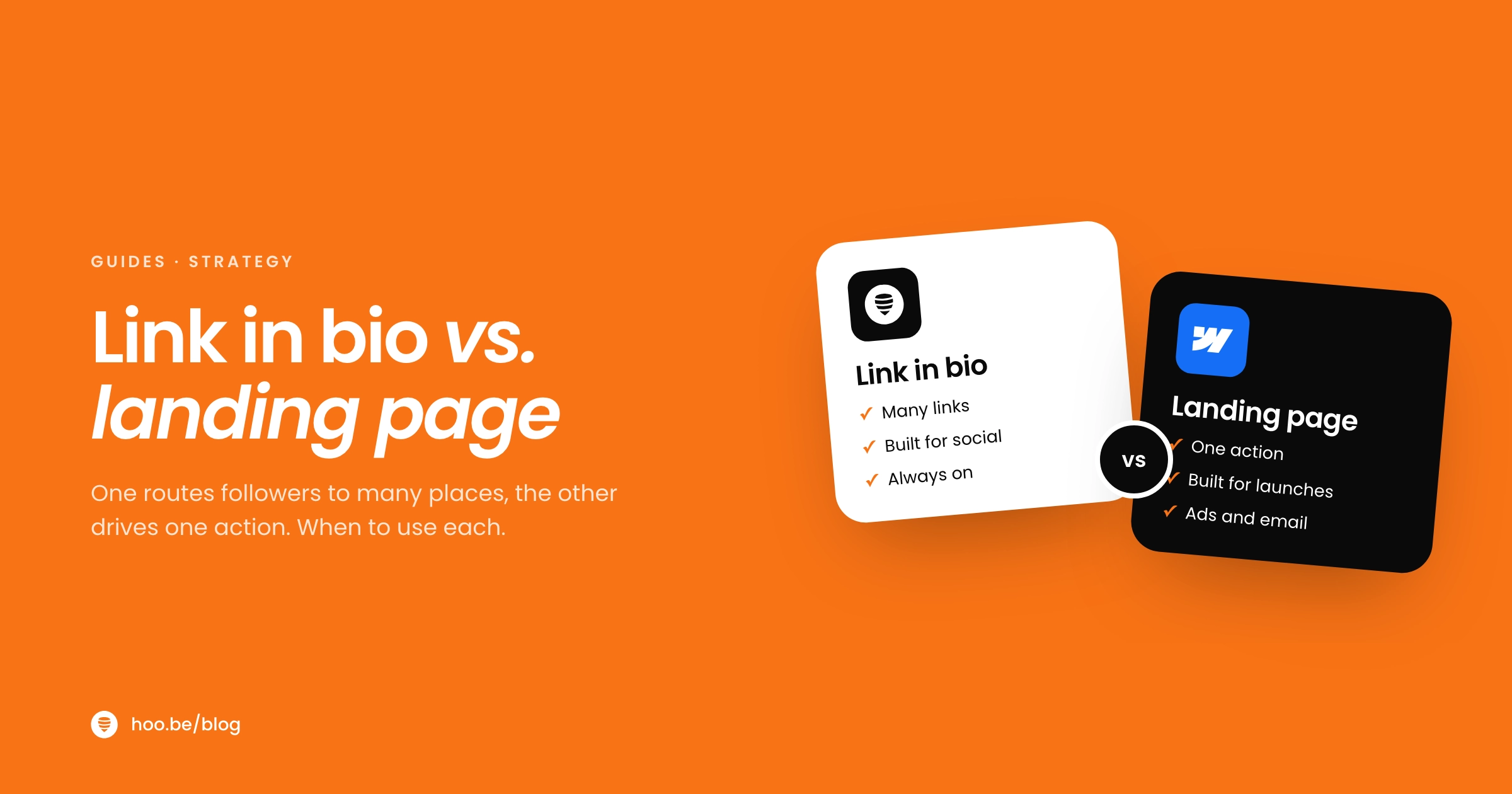
A link in bio page is a hub: one mobile page with several links, built to route followers from a social profile to wherever they want to go next. A landing page is a funnel: one page built around a single action, such as joining a list or buying a product, with everything else removed. The difference comes down to choice versus focus.
You do not have to pick one forever. Most creators run a link in bio page every day and point it at a landing page when they have one offer that needs explaining, like a course launch, a waitlist or a paid workshop.
This guide compares the two side by side, shows what the data says about conversion, and gives you a simple way to decide which one your link should open right now.
Key takeaways
- A link in bio page offers several choices and routes traffic. A landing page asks for one action and removes distractions.
- Use a link in bio page for everyday social traffic. Use a landing page for a single high-value offer, a launch or paid ads.
- Landing pages convert at a median of 6.6% across industries in Unbounce's analysis of more than 41,000 pages.
- 83% of landing page visits in that dataset came from mobile, so both page types must be built for phones first.
- The best setup is usually both: a link in bio hub, with your current offer at the top linking to its own landing page.
What is the difference between a link in bio and a landing page?
Both are single web pages that people reach by tapping a link. They are built for opposite jobs.
| Link in bio page | Landing page | |
|---|---|---|
| Goal | Help visitors find what they want | Get visitors to take one action |
| Number of links | Several, one per destination | Ideally one call to action |
| Length | Short, mostly buttons and blocks | Longer: headline, benefits, proof, form |
| Traffic source |  Instagram,  TikTok,  YouTube profiles | Ads, emails, a featured link, partner promotions |
| Lifespan | Permanent, updated often | Often tied to one campaign |
| Setup time | Minutes | Hours to days |
| Success metric | Clicks per link, page views | Conversion rate on one goal |
Put simply: a link in bio page answers "where should I go?" and a landing page answers "why should I do this?"
What is a link in bio page built for?
Social apps limit links. Instagram lets you add up to five links to a profile, and TikTok only allows a profile website link once you have 1,000 followers or a verified business account. A link in bio page turns that one slot into a menu, so a follower who just watched your video can find the product, the full episode or your newsletter in one tap.
Its strengths come from flexibility:
- It serves every visitor. New followers, returning fans and brand managers each find something different.
- It is always current. You update one page and every profile points to the latest thing.
- It shows you what people want. Click data per link tells you which content and offers pull.
Its weakness is the same flexibility. Every extra link competes for the tap. If you want people to do one thing today, a page with twelve equal buttons makes that harder. Our guide on what to add to your link in bio covers how to order links so the important one wins.

What is a landing page built for?
A landing page exists to convert. It is usually built for one campaign and one audience, and it walks the visitor from interest to action on a single page:
- A clear headline that matches the post, ad or email that sent them.
- The offer and its benefits, in plain language.
- Proof, such as results, reviews or a preview of what they get.
- One call to action: a form, a buy button or a booking slot.
- No exits: no menu, no social icons, no unrelated links.
That focus is why marketers build a separate landing page for each campaign. It also makes results easy to measure, because there is only one thing to count.
Which converts better, a link in bio page or a landing page?
For a single offer, a landing page usually does, because it removes choices and makes the case in full. For general social traffic, the comparison does not quite work: a link in bio page is not trying to convert everyone to one thing, it is trying to get each visitor to the right place.
The best public benchmark for landing pages comes from Unbounce, which analyzed 41,000+ landing pages, 464 million visitors and 57 million conversions for its most recent Conversion Benchmark Report.
Two findings in that report apply to any page you send social traffic to, link in bio or landing page. First, mobile dominates: 83% of visits came from phones, and mobile visitors converted 8% worse than desktop visitors. Second, simple writing wins by a wide margin.
Landing page conversion rate by reading level
Pages written at a 5th to 7th grade reading level converted at more than double the rate of pages written at a professional level. Short words and short sentences matter even more on a phone screen, which is exactly where your bio link opens.
Pro tip
Write every button on your link in bio page as a short promise, not a label. "Shop" says little. "Get the 10-minute skincare routine" tells the visitor what happens when they tap. Then make the landing page headline repeat that same promise, so the visitor knows they are in the right place.
When should you use a link in bio page?
Use a link in bio page as your default whenever traffic comes from a social profile and visitors want different things. That covers most days for most creators.
- You share several things at once: new videos, an affiliate shop, a podcast, a newsletter, brand work.
- Your audience is mixed: fans, new followers and brand managers all tap the same link.
- You post often and want one place to point people that you can update in seconds.
- You earn from many small actions such as affiliate clicks, tips and product links, rather than one big sale.
A link in bio page can also carry landing-page-style blocks. An email signup form, a product block with a price and buy button, or a featured link at the top all work as small, focused calls to action inside the hub. Our guide to building an email list from your link in bio shows how far that can go.
When should you use a landing page?
Build a dedicated landing page when one offer deserves the whole page:
- A launch: a course, a membership, a product drop or a waitlist.
- A higher-priced offer that needs explanation, proof and answers to objections before someone pays.
- Paid ads, where you pay per click and want every visitor focused on one action.
- A lead magnet, such as a free guide in exchange for an email address.
- A partner promotion, where a brand or collaborator sends their audience to one specific offer.

Can you use a link in bio page and a landing page together?
Yes, and it is usually the best setup. The link in bio page stays as your permanent hub. When you have a campaign, the landing page becomes the first, most prominent link on it. Here is how to run it.
- Build the landing page for the offer. One headline, the benefits, proof and a single call to action. Keep the copy simple.
- Feature it at the top of your link in bio page. Give it the strongest button, a clear label and an image if your tool supports it.
- Say it in your content. "The link in my bio, first button" removes guesswork for viewers.
- For a short launch window, consider sending the bio link straight to the landing page. Some tools let you redirect your bio link temporarily, so one tap opens the offer.
- Measure both pages. Clicks on the featured link tell you how well your content sells the offer. The landing page's conversion rate tells you how well the page closes it.
- Switch back when the campaign ends. Move the landing page link down or remove it, and restore your normal hub.
Keep the path short
TikTok's help center says its in-app browser limits how far visitors can browse through chains of external links, and recommends direct links so people reach the intended site in a few steps. Link from your bio page straight to the landing page, and from the landing page straight to checkout. Avoid stacking link pages on top of each other.
How do you make a link in bio page convert better?
You can borrow the best habits of landing pages without losing the flexibility of a hub.
- Lead with one featured action. Your current offer, launch or newest video goes first, visually bigger than the rest.
- Cut links you would not miss. Fewer choices make the remaining ones easier to pick.
- Match the language of your posts. If the video says "free meal plan," the button should too.
- Use simple words. The Unbounce data above shows plain writing converts better, and phones make long text harder to read.
- Add one way to stay in touch. An email or contact form captures visitors who are not ready to buy yet.
- Track every link and review it monthly. Our link in bio audit and the list of common link in bio mistakes make this quick.
If you want your page to drive income rather than just traffic, our guide to turning your link in bio into a revenue driver goes further, and what is a link in bio tool covers the basics if you are just starting.
How does hoo.be handle both?
hoo.be is a link in bio platform, so your page at hoo.be/yourname works as the everyday hub. It is built from blocks, and several of them behave like landing page sections:
- Product blocks with a price and shop button, and product links that recognize 30 shopping platforms including Amazon, Etsy and Shopify.
- Contact collection and forms with text, email, phone, select, yes/no and address fields. Responses export to CSV.
- Events with upcoming dates and ticket links, and tips from $1 to $500 through Stripe.
- Tracking through Facebook Pixel, TikTok Pixel and Google Analytics, useful if you run ads to your page.
On the Pro plan you can also schedule pages, set a scheduled redirect link for launches, add custom SEO and see 90-day, all-time and custom analytics ranges with referrer, device, country and city breakdowns. See hoo.be/pricing for current plans.
One page for every day, ready for every launch
Build your hoo.be hub with links, products, forms and tips, then feature your next offer at the top when it is time to launch. Free to start.
Claim your hoo.beFrequently asked questions
What is the difference between a link in bio and a landing page?
A link in bio page holds several links and helps visitors from a social profile choose where to go. A landing page is built around one action, such as a signup or purchase, and removes other links. One routes traffic, the other converts it.
Is a link in bio page a landing page?
Technically it is the page visitors land on, but it is not a landing page in the marketing sense. A marketing landing page has one goal and one call to action. A link in bio page has several. You can make a link in bio page more focused by featuring one action at the top.
Which converts better, a link in bio or a landing page?
For one specific offer, a landing page usually converts better because it removes competing choices. Unbounce's benchmark puts the median landing page conversion rate at 6.6%. For everyday social traffic with mixed intent, a link in bio page serves more visitors well.
Should I put a landing page link in my Instagram bio?
During a launch, yes: either feature the landing page at the top of your link in bio page or point your bio link straight to it for a short time. Instagram allows up to five profile links, so you can also add the landing page as a second link while keeping your hub as the first.
Do I need a website if I have a link in bio page?
Not to start. A link in bio page covers most needs for creators whose audience comes from social apps. Add a website or dedicated landing pages when you need long-form content, search traffic, or focused pages for launches and ads.
How many links should a link in bio page have?
As few as you can manage, usually one featured action plus three to six supporting links. Every extra link competes for attention. Review your click data monthly and remove links that rarely get tapped.
Can a link in bio page collect emails like a landing page?
Yes. Most link in bio tools include an email or contact form block. Put it high on the page with a clear reason to sign up, such as a free guide or early access, and it works like a small landing page inside your hub.