In this article
- What is the difference between a UGC creator and an influencer?
- What does a UGC creator actually do?
- What does an influencer get paid for?
- Who earns more, UGC creators or influencers?
- Do you need followers to be a UGC creator?
- How do usage rights and whitelisting change the price?
- What are the disclosure rules for UGC and influencer content?
- How do you start as a UGC creator?
- Can you be both a UGC creator and an influencer?
- Frequently asked questions
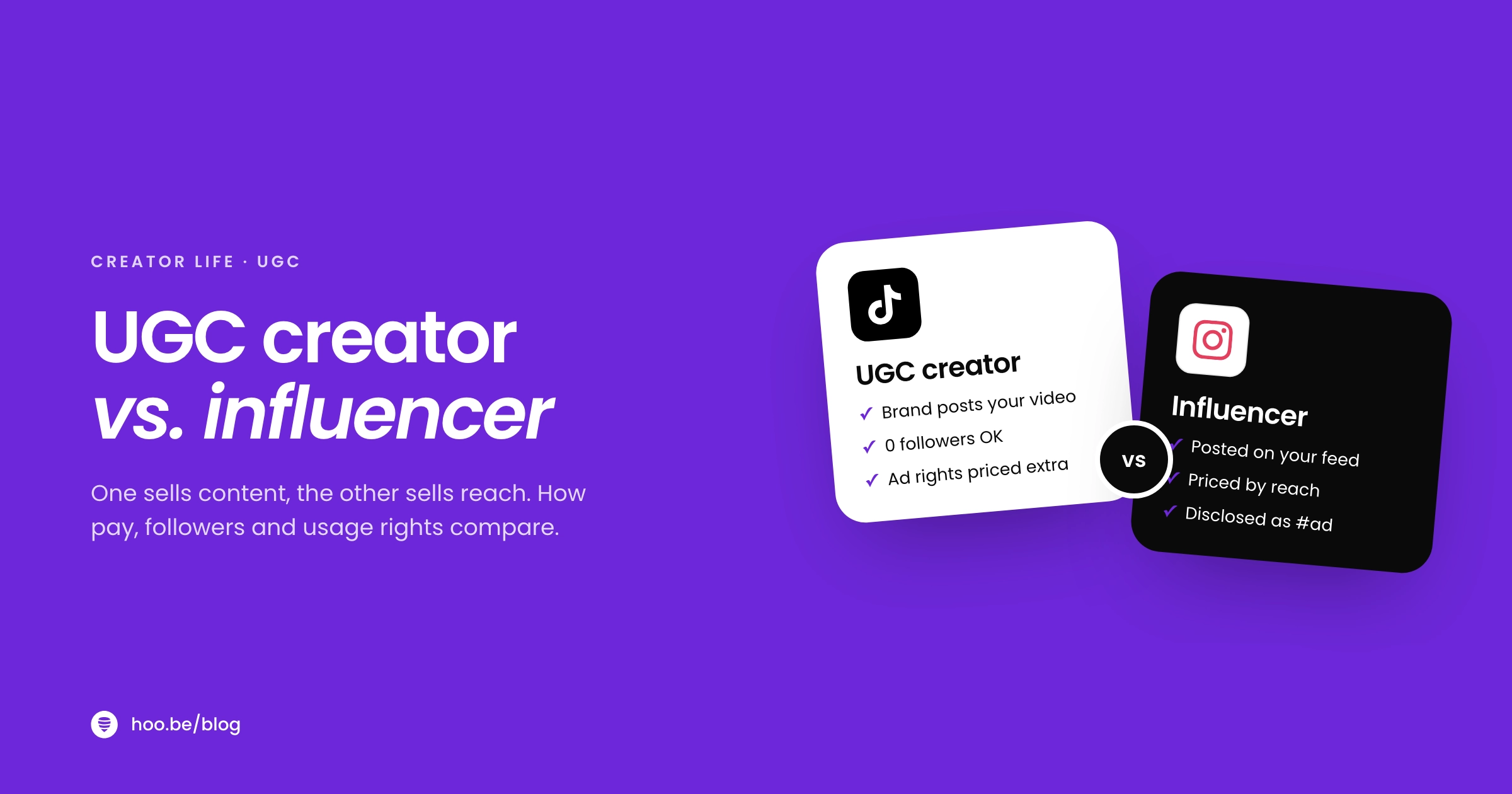
A UGC creator is paid for the content. An influencer is paid for the audience. That one line explains almost every other difference between the two jobs: who posts the video, whether follower count matters, how rates are set, and what you need to disclose.
The line between them is also getting busier. UGC grew from 15% to 35% of all campaigns on Collabstr's creator marketplace in 2025, and brands now routinely ask influencers for ad rights on top of the post. If you are deciding where to start, or how to price a deal that mixes both, you need to know exactly what a brand is buying.
This guide compares the two side by side with 2026 pay data, explains usage rights, Spark Ads and partnership ads in plain terms, and gives you a step-by-step way to start as a UGC creator even with zero followers.
Key takeaways
- UGC creators sell content that the brand posts or runs as ads. Influencers sell reach: the post lives on their own account and the value is their audience.
- You need no followers to do UGC. Brand marketplaces like TikTok One start at 10,000 followers, and YouTube's brand deal tools require the YouTube Partner Program.
- On Collabstr in 2025, brands paid an average of $154 per UGC collaboration, against $193 for Instagram and $255 for YouTube influencer work.
- Usage rights, whitelisting and exclusivity are where the extra money is. Nowadays Media puts the uplift at 30% to 200% on top of a base rate.
- Both jobs fall under FTC rules. Influencers must disclose paid posts, and since October 2024 nobody can pass off a testimonial for a product they never used.
What is the difference between a UGC creator and an influencer?
A UGC creator (user-generated content creator) makes photos and videos that look like real customer content, then hands them to the brand. The brand posts them on its own account, puts them on product pages, or runs them as paid ads. Your audience is not part of the deal.
An influencer publishes sponsored content on their own account. The brand is paying to reach the people who already trust you, so your follower count, engagement rate and audience demographics drive the price.
| UGC creator | Influencer | |
|---|---|---|
| What the brand buys | The content itself | Access to your audience |
| Where it is posted | Brand's account, website, ads | Your account |
| Followers needed | None | Usually 1,000+; 10,000+ for some marketplaces |
| How price is set | Per deliverable, plus usage rights | By reach, engagement and format |
| Typical deliverable | Raw video, edited ad, hooks, photos | Reel, TikTok, YouTube integration, Stories |
| Who owns the audience effect | The brand | You |
| Main skill | Scripting, filming, editing for conversion | Building a community that trusts you |
Neither job is "better." UGC is the fastest way to get paid for creative work. Influence is slower to build but compounds, because every new follower makes your next deal worth more.
What does a UGC creator actually do?
Most UGC briefs ask for short vertical videos that feel native to TikTok, Reels and Shorts. The common formats are product demos, unboxings, "how I use it" tutorials, problem and solution videos, honest reviews and talking-head testimonials. Many brands also ask for several hook variations so their ad team can test which opening keeps people watching.

Brands want this content because it is cheap to produce at volume and it works on any channel. Collabstr's 2026 report notes that UGC campaigns are driven mainly by smaller businesses, with more than 40% of UGC campaigns coming from companies spending under $5,000. For a small brand, a stack of UGC videos replaces a photo shoot, a studio and a creative agency.
Some UGC never appears on social media at all. It ends up on product pages, in email campaigns or in paid ads that run from the brand's handle. That is why the contract, not the video, decides how much a UGC job is really worth.
When UGC runs from your handle
A growing share of briefs sit between the two jobs. The brand wants your video to run as an ad that shows your name at the top. On TikTok this is a Spark Ad: you open the post's Ad settings, generate a code and send it to the brand, which can then promote your organic post. On Instagram and Facebook it is a partnership ad (Meta's new name for branded content ads), which Meta calls the most performant and transparent way for advertisers and creators to run ads together.
These ads borrow your credibility, so they should cost more than plain UGC. Price them as a separate line item.
What does an influencer get paid for?
An influencer is paid for attention that already exists. When a brand books you for a Reel, it is buying a place in the feed of people who chose to follow you. Meta's own research shows why that matters: 53% of people surveyed said they are more likely to buy an item if a creator has promoted it on Reels.
That is also why influencer pricing tracks audience size. Nowadays Media's 2026 Instagram rates, based on more than $17 million in placed spend, show how quickly the numbers climb by tier:
| Tier | Followers | Feed post | Reel | Story |
|---|---|---|---|---|
 Nano | 1K to 10K | $25 to $150 | $50 to $300 | $15 to $75 |
| Micro | 10K to 100K | $150 to $500 | $300 to $800 | $50 to $250 |
| Mid | 100K to 500K | $500 to $2,500 | $800 to $5,000 | $200 to $800 |
| Macro | 500K to 1M | $2,500 to $10,000 | $5,000 to $15,000 | $500 to $2,000 |
Source: Nowadays Media, Instagram Influencer Rates 2026 (June 2026). Single-deliverable organic posting; usage rights are extra.
Influencers also earn in ways UGC creators usually do not: affiliate commissions, platform payouts, ambassador retainers and sales of their own products. Our guide to landing your first brand deal covers the influencer side in detail.
Who earns more, UGC creators or influencers?
Per job, influencers usually earn more once they have a real audience. Per hour, and especially in your first year, UGC often wins, because you can take paid work from day one.
Collabstr's marketplace data separates what creators ask for from what brands actually pay after negotiation. Here is the paid side, by platform:
Average paid per collaboration on Collabstr, 2025
Two things to keep in mind. First, marketplace averages skew small, because most brands on open marketplaces are small businesses. Experienced UGC creators who pitch brands directly, and influencers with large audiences, charge well above these numbers. Second, the gap between asking and paid prices is real: UGC creators on Collabstr list packages at $180 on average but are paid $154. Negotiation happens, so build room for it into your rate card.
The demand trend favours UGC. In Influencer Marketing Hub's 2026 benchmark of more than 600 brands and agencies, half of respondents plan to grow their spending on UGC creators. For a full price breakdown, see our UGC creator rates guide.
Do you need followers to be a UGC creator?
No. A UGC brief is judged on your portfolio, not your profile. That is the biggest practical difference between the two paths, and it shows in the entry requirements for the official brand deal tools, which are built for influencers:
| Where brands find creators | Who it is for | Entry requirement |
|---|---|---|
 TikTok One (Creator Marketplace) | Influencers | 18+, 10,000 followers, 1,000 post views and 3 posts in the last 30 days |
 YouTube Creator Partnerships | Influencers | 18+, in the YouTube Partner Program, no active strikes, available country |
| Meta Creator Marketplace | Influencers | Professional account with an "authentic, established presence" and sufficient followers |
| UGC marketplaces and direct pitches | UGC creators | A portfolio of sample videos |
Requirements from each platform's help centre, checked October 2026. Thresholds can vary by region.
Followers still help a UGC creator in one way: brands that want Spark Ads or partnership ads from your handle prefer accounts that look active and credible. But you can sign your first paid UGC job before you post anything on your own feed.

How do usage rights and whitelisting change the price?
This is the part most new creators underprice. A base UGC fee or influencer fee buys the content for a narrow use. Everything beyond that is a licence, and licences cost extra.
- Organic usage. The brand can post your content on its own social accounts. Often included in UGC fees, but state it in writing.
- Paid usage. The brand can run your content as ads. Charge for it and set a time limit, such as 30, 60 or 90 days.
- Whitelisting. The ad runs from your handle (Spark Ads on TikTok, partnership ads on Meta). Your name and credibility are on the line, so this is the most valuable licence.
- Exclusivity. You agree not to work with competitors for a period. That is income you give up, so price it like lost income.
Nowadays Media's 2026 data puts usage rights, exclusivity and whitelisting at 30% to 200% on top of base rates. Our guide to negotiating usage rights has scripts for each.
Pro tip
Quote usage as separate line items, never a single bundled number. "Video: $200. Paid usage, 60 days: $100. Spark Ads code, 60 days: $100." When the brand asks for a discount, you can trim a licence instead of cutting the price of your work.
What are the disclosure rules for UGC and influencer content?
In the US, both jobs fall under the FTC, but in different ways.
Influencers: disclose every material connection
If you post about a brand you have a financial, employment, personal or family relationship with, including free products, you must disclose it. The FTC's guidance says disclosures should be hard to miss: put them in the post itself, not behind a "more" link, and in videos say it and show it on screen. Plain words work best: "Ad," "Sponsored" or "Thanks to [Brand] for the free product." Use the platform's paid partnership label too, but do not rely on it alone.
UGC creators: only say what is true
When a brand posts your video as its own ad, the ad is the brand's speech, but your words still matter. The FTC's Consumer Reviews and Testimonials Rule, in effect since October 21, 2024, bans testimonials that misrepresent that they come from someone who actually used the product. The FTC says influencers who sell testimonials could be liable if they lie about having used a product or about their experience with it. Practically: use every product you review, never read a script that claims results you did not get, and push back on briefs that ask you to.
Disclosure rules outside the US differ, so check your local advertising regulator if you work with brands abroad.
How do you start as a UGC creator?
- Pick two or three product categories you know. Skincare, kitchen gadgets, apps, pet products. Brands hire creators who look like their customers.
- Film three to five spec videos. Use products you already own. Make one demo, one unboxing, one problem and solution video and one testimonial, each with two different hooks.
- Build a portfolio page. Put your samples, the formats you offer, starting rates and a contact form in one link. A link in bio portfolio works well because brands can watch your videos without downloading anything.
- Write a simple rate card. One price per video, then separate prices for extra hooks, raw footage, paid usage and whitelisting. Our media kit guide shows the layout.
- Pitch ten brands a week. Target small and mid-sized brands that already run ads. Keep the email short and link to your portfolio. Use our brand pitch templates.
- Get every term in writing. Deliverables, revisions, usage scope and length, payment date and whether you can show the work in your portfolio.
Our first 30 days as a UGC creator plan turns these steps into a daily schedule.
Can you be both a UGC creator and an influencer?
Yes, and it is increasingly the norm. Many creators take UGC jobs for income while they grow their own account, then add influencer deals once their audience is big enough. The skills overlap almost completely: hooks, pacing, lighting and clear product demos work in both.

Two rules keep the hybrid model clean. First, keep separate rate cards, so a brand that wants your audience cannot pay UGC prices for a post on your feed. Second, watch exclusivity: a UGC contract that blocks you from a whole category can stop you from taking a better influencer deal later.
The sweet spot for many creators is UGC with a whitelisting upsell. You deliver the video for the brand's ads, then charge a licence fee for running it from your handle. That pays you for your content and your credibility without spending a post on your own feed.
Turn your link in bio into a portfolio brands can book
hoo.be lets you show your best TikTok, Instagram and YouTube work with embeds and carousels, collect brand inquiries with a contact form, and export every lead to CSV. Free to start.
Build your page on hoo.beFrequently asked questions
What is the main difference between a UGC creator and an influencer?
A UGC creator is paid for content that the brand posts on its own channels or runs as ads. An influencer is paid to post on their own account, so the brand is buying access to their audience. UGC pricing is based on deliverables; influencer pricing is based on reach and engagement.
Do you need followers to become a UGC creator?
No. Brands hire UGC creators based on a portfolio of sample videos, not follower count. Influencer marketplaces do have thresholds: TikTok One requires 10,000 followers, and YouTube Creator Partnerships requires membership of the YouTube Partner Program.
How much do UGC creators make per video in 2026?
On Collabstr's marketplace, brands paid an average of $154 per UGC collaboration in 2025, and UGC creators listed packages at $180 on average. Experienced creators who pitch directly charge more, and paid usage, whitelisting and exclusivity add 30% to 200% on top.
Who makes more money, UGC creators or influencers?
Influencers usually earn more per post once they have a large, engaged audience, because pricing rises with reach. UGC creators can earn from day one with no audience, so UGC often pays better early on. Many creators do both.
What is whitelisting in UGC?
Whitelisting means a brand runs ads from your account handle rather than its own. On TikTok this is done with a Spark Ads code; on Instagram and Facebook it is a partnership ad. Because your name appears on the ad, charge a separate, time-limited fee for it.
Do UGC creators need to disclose ads?
If you post sponsored content on your own account, yes: the FTC requires a clear disclosure of any material connection. When the brand posts your UGC as its own ad, the brand is responsible for the ad, but the FTC's 2024 rule still bans testimonials from people who did not actually use the product.
Can you be a UGC creator and an influencer at the same time?
Yes. Many creators take UGC work for steady income while they grow their own audience. Keep separate rate cards for each, and read exclusivity clauses carefully so a UGC contract does not block a bigger influencer deal.
Sources
- Collabstr, 2026 Influencer Marketing Report
- Influencer Marketing Hub, Influencer Marketing Benchmark Report 2026 (May 2026)
- Nowadays Media, Instagram Influencer Rates 2026 (Jun 2026)
- Meta for Business, Meta at IAB NewFronts 2025
- Meta Newsroom, Making it easier for brands and creators to collaborate on Instagram (Feb 2024)
- Instagram Help, Eligibility requirements for partnership ads and branded content
- Instagram Help, About Meta Creator Marketing Hub
- TikTok Ads Help, How to create Spark Ads
- TikTok Support, TikTok One eligibility
- YouTube Help, Get started with YouTube Creator Partnerships
- FTC, Disclosures 101 for Social Media Influencers
- FTC, Final rule banning fake reviews and testimonials (Aug 2024)
- FTC, Consumer Reviews and Testimonials Rule: Questions and Answers