In this article
- What should a beauty creator put in their link in bio?
- Why does your link in bio matter so much for beauty?
- Which affiliate programs pay beauty creators the most?
- How should you organize beauty products in your link in bio?
- How do you show brands you are worth partnering with?
- How do you set up a beauty link in bio, step by step?
- Should beauty creators collect emails?
- How do you disclose affiliate links and gifted products?
- How do you know which links are earning?
- Frequently asked questions
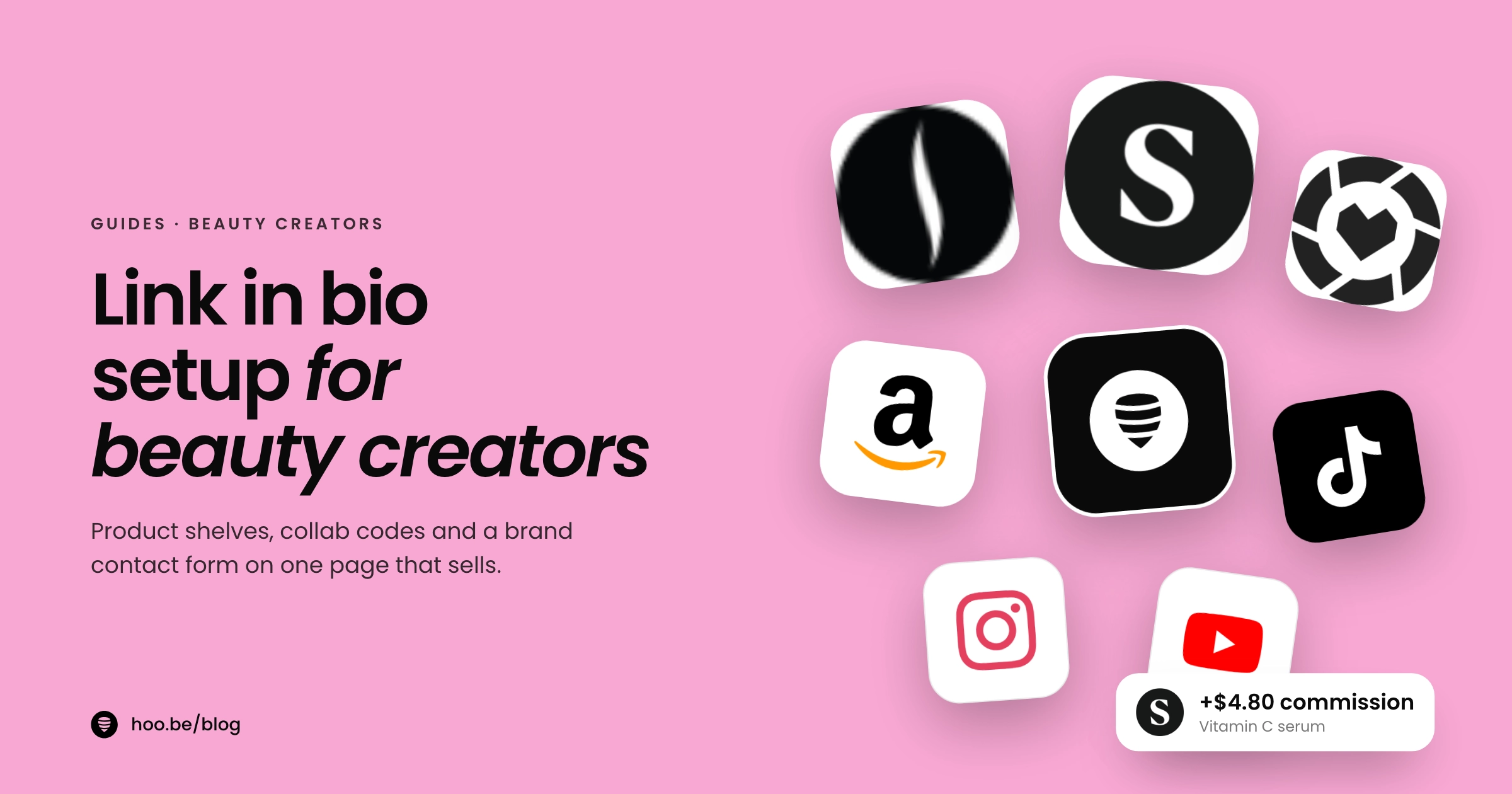
The best link in bio setup for beauty creators does three jobs in order: it answers "what product is that?" in one tap, it shows brands you are worth paying, and it captures the followers who are not ready to buy yet. Put your current routine or most-asked products first, your shop by category second, then collabs, latest content, a newsletter signup and a business contact form.
Why the urgency? Beauty is now one of the most shoppable categories on social media. NielsenIQ found that 53% of consumers have bought through social platforms, and beauty makes up 46% of all consumer-goods sales on TikTok Shop. Your followers are already shopping from creators. The question is whether they shop through your links or someone else's.
This guide walks through what to include, which affiliate programs pay beauty creators the most in 2026, how to organize products so people actually buy, and how to set the whole page up in an afternoon.
Key takeaways
- Lead with the product people ask about most, not your socials. Every comment asking "what shade is that?" should have an answer one tap away.
- Commission rates vary a lot: Amazon pays 3% on most beauty and 10% on Luxury Beauty, Sephora's storefront pays 15%, and LTK and ShopMy brands typically pay 10% to 30%.
- Organize your shop by routine or concern (skin prep, base, glow, fragrance), not as one long list of links.
- Give brands a clear path: current collabs near the top, a media kit link and a contact form, so deals stop getting lost in your DMs.
- Disclose affiliate links and gifted products in the post itself. The FTC says a disclosure only in your bio is not enough.
What should a beauty creator put in their link in bio?
Think of your link in bio as a small beauty counter. Someone walks up with one question, and you have a few seconds to answer it before they leave. Here is the order that works for most beauty creators, from the top of the page down:
- Your current routine or "as seen in my last video." The products from your latest tutorial, GRWM or review. This is what most visitors came for.
- Your shop, grouped by category. Skincare, base, eyes, lips, hair, tools, fragrance. Or by concern: acne-prone, dry skin, sensitive, mature skin.
- Current brand collaborations and discount codes. A live code is both a reason to buy and proof to other brands that you deliver.
- Your latest tutorial or review. An embedded video keeps new visitors watching instead of bouncing.
- A newsletter or restock-alert signup. For the followers who love your content but are not buying today.
- A business contact form and media kit. The front door for brands and agencies.
- Your social icons. At the bottom. Visitors who tapped your bio already follow you somewhere.
If you only have time to do one thing today, do the first item. Our list of common link in bio mistakes starts with the same problem: pages that make visitors hunt for the one thing they came for.

Why does your link in bio matter so much for beauty?
Because beauty buyers now discover and buy on social apps, and the apps give you very little room to send them anywhere. Instagram lets you add up to five links to your bio, but it shows only the first one and hides the rest behind a count. TikTok only makes your bio link clickable once you have 1,000 followers or switch to a business account. One well-built page is how you fit a whole shop into that space.
NielsenIQ's 2026 research shows how much shopping already happens there:
The same NIQ report found that the global beauty market grew 10% year on year, with e-commerce growing six times faster than in-store sales. Social video is creating brand-new online beauty shoppers, and many of them meet the product through a creator first.
That traffic is valuable, and it is fragile. A tutorial can send thousands of people to your profile in a weekend. If your bio link goes to a generic homepage or a single outdated product, most of that intent is lost. A link in bio built for beauty turns it into commissions, email subscribers and brand interest.
Which affiliate programs pay beauty creators the most?
Most beauty creators earn from a mix of retailer programs and creator-commerce platforms. Rates are set by category or by each brand, so the same lipstick can pay very differently depending on where you link it. Here is how the main options compare in 2026.
| Program | Typical beauty commission | Entry requirements | Good to know |
|---|---|---|---|
 Amazon Associates Amazon Associates | 3% Beauty, 10% Luxury Beauty, 1% Health and Personal Care | Open application | Fixed rates by category. Shoppers already have accounts, so checkout is easy. |
 My Sephora Storefront My Sephora Storefront | 15% | US creators with 3,000+ followers on Instagram, TikTok or YouTube | 15-day attribution window. Shoppers check out on Sephora and keep their Beauty Insider points. |
 LTK LTK | Typically 10% to 25%, set by each brand | Application. Outside the US and Canada, at least 5,000 followers | Your products also appear in the LTK app, which LTK says reaches 40 million shoppers a month. |
 ShopMy ShopMy | 10% to 30%, set by each brand | Application | 47,000+ brands offer commission. Pays every Friday through PayPal or Stripe. |
Sources: Amazon Associates commission rates, Sephora newsroom and Glossy, LTK FAQs and ShopMy. Rates as of October 2026 and set by each program or brand.
The gap is easiest to see on a single basket. Here is what a $100 order earns you at each fixed rate:
What you earn on a $100 beauty order
Higher commission is not automatically better. A follower who already has Prime and a saved card may buy a $25 cleanser on Amazon without thinking, while the same person might abandon a new checkout on an unfamiliar site. Many creators link everyday staples to Amazon, prestige products to Sephora, and indie or premium brands through ShopMy or LTK. Our guides to the Amazon Influencer Program and ShopMy sales from your link in bio go deeper on each.
Pro tip
Check where a product actually pays best before you link it. The same serum can be 3% on Amazon, 15% through Sephora's storefront, or a brand-set rate on ShopMy. For your ten most-clicked products, spend five minutes comparing. It is one of the quickest ways to earn more from traffic you already have.
How should you organize beauty products in your link in bio?
The way people shop beauty is by routine and by problem. Nobody thinks "I want product number 47." They think "what was the glowy base in that video" or "what do you use for dry skin in winter." Organize your shop the way they think.
Group by routine or concern
Create a small number of clear sections. Five to eight is plenty. Good examples for a beauty creator:
- Latest video: every product from your newest tutorial, in the order you used them.
- Everyday routine: your morning and night skincare, step by step.
- By concern: acne-prone, dry, sensitive, hyperpigmentation.
- Under $20: drugstore favorites.
- Tools and hair: brushes, sponges, heat tools, accessories.
Name links like answers, not labels
"Shop" tells nobody anything. "The tinted SPF I wear every day" does. Short, specific link titles get more taps because they match the question a visitor already has in their head.
Keep the top fresh
Swap the top section every time you post a new tutorial. A page that still features last month's routine tells visitors the page is not maintained, and they stop checking it.

How do you show brands you are worth partnering with?
When a brand clicks through to your link in bio, it should see three things within a few seconds: who you already work with, what your audience buys, and how to reach you.
- Feature live collaborations. Put current partnerships and discount codes near the top with the brand's name in the title. It doubles as a portfolio.
- Link your media kit. Audience demographics, engagement, past results and rates. If you do not have one yet, follow our creator media kit guide.
- Use a contact form, not just an email address. A form with fields for brand, budget and timeline filters serious enquiries and keeps them out of your DMs.
- Show what you make. Embed one or two of your best-performing tutorials so a brand can see your production quality without leaving the page.
When you are ready to reach out first, our guide on how to land your first brand deal covers pitching, pricing and what to send.
How do you set up a beauty link in bio, step by step?
You can build a complete page in an afternoon. Do it in this order so the most valuable parts go live first.
- Join two affiliate programs. One retailer program (Amazon Associates, or Sephora's storefront if you qualify) and one creator platform (LTK or ShopMy).
- List your 20 most-asked products. Go through your comments and DMs from the last month. These are your first links.
- Create your sections. Latest video, everyday routine, by concern, under $20, tools. Add products to each.
- Write link titles as answers. "My holy-grail concealer" beats "Concealer." Add a product image to every link where possible.
- Add collabs and codes near the top. One block per live partnership, with the brand name and code visible.
- Embed your latest tutorial. Pick the video that is driving the most profile visits right now.
- Add a signup and a contact form. A short email signup for fans and a business form for brands.
- Put the link everywhere. Instagram bio (as your first link), TikTok bio, YouTube channel links and video descriptions.
- Review weekly. Move top-clicked products up, remove sold-out or discontinued items, and refresh the top section with each new post.
Should beauty creators collect emails?
Yes, and beauty is one of the best niches for it. Products launch, sell out, restock and go on sale constantly, and each of those moments is a reason to email your followers. A restock alert for a sold-out product reaches people who already decided they want it, with no algorithm in between.
Keep the signup simple: an email field and a clear promise, such as "Restocks, dupes and the sales worth knowing about, twice a month." Our guide to building an email list from your link in bio covers what to offer and how often to send.
An email list also protects you. Algorithms change and accounts get restricted. Your list is the one audience you can reach whatever happens to a platform.
How do you disclose affiliate links and gifted products?
In the US, the FTC requires you to disclose any material connection to a brand, which includes affiliate commissions, payments and free products. Its guidance for influencers is specific about placement: a disclosure that appears only on a profile or "about me" page is likely to be missed, so it does not count on its own.
- Disclose in the post or video itself. Say it out loud in videos and put it on screen, not only in the caption.
- Use plain words. "Ad," "sponsored" or "thanks to [brand] for the free product." Avoid vague tags like "sp" or "collab."
- Use platform tools as well, not instead. The paid partnership label helps, but the FTC says not to rely on it alone.
- Label your link in bio too. A short line such as "Some links are affiliate links and I may earn a commission" is good practice, in addition to disclosing in each post.
The FTC's Disclosures 101 for Social Media Influencers is short and worth reading once.
Watch out
Gifted PR packages count as a material connection. If a brand sent you the product for free, say so, even if you were not paid and even if you would have bought it anyway.
How do you know which links are earning?
Look at your numbers once a week. Your affiliate dashboards tell you what sold. Your link in bio analytics tell you what people clicked and where they came from. Together they show which products deserve the top spot.
- Clicks per link: move the top five to the top of the page.
- Traffic source: if TikTok sends most visits, feature the products from your TikToks first.
- Clicks with no sales: a product people tap but do not buy may be out of stock, overpriced, or linked to the wrong retailer.
Run a fuller link in bio audit once a month to catch broken links and stale sections.
Building it on hoo.be
hoo.be was built for creators who sell what they recommend. Product links recognize 30 shopping platforms, including Amazon, LTK, ShopMy and Sephora, and there is a dedicated field for your Amazon affiliate tag. Carousel blocks give you swipeable product shelves for each routine, and you can embed your latest YouTube, TikTok or Instagram tutorial directly on the page.
For brand work, Contact collection and Forms blocks capture enquiries and signups, and you can export them to CSV. Analytics include a Links tab and a Shop tab so you can see what gets tapped, and you can add a Facebook Pixel, TikTok Pixel or Google Analytics ID.
Turn "what product is that?" into a sale
Build a beauty page on hoo.be with product shelves, collab codes, your latest tutorial and a contact form for brands. Start on the Free plan and see hoo.be/pricing for Pro and Premium.
Claim your hoo.beFrequently asked questions
What is the best link in bio setup for beauty creators?
Start with the products from your latest video, then a shop grouped by routine or skin concern, current brand collabs and discount codes, an embedded tutorial, an email signup and a business contact form. Put social icons last, since visitors already follow you somewhere.
Which affiliate program pays the most for beauty products?
It depends on the product. Amazon Associates pays 3% on most beauty and 10% on Luxury Beauty. My Sephora Storefront pays 15% with a 15-day attribution window. Brands on LTK typically pay 10% to 25%, and brands on ShopMy pay 10% to 30%.
How many followers do you need to join Sephora's creator storefront?
My Sephora Storefront is open to US creators with at least 3,000 followers on Instagram, TikTok or YouTube. Creators apply through Sephora's creator site, and shoppers check out on Sephora while earning Beauty Insider points.
Can I add more than one link to my Instagram bio?
Yes. Instagram allows up to five links in your bio, but it shows only the first one on your profile and hides the rest behind a count. That is why most beauty creators use one link in bio page as their first link and keep everything else there.
Why can't I add a link to my TikTok bio?
TikTok makes the bio website link clickable once you reach 1,000 followers, or straight away if you switch to a business account. Below that, a URL typed into your bio shows as plain text.
Do I need to disclose affiliate links in my link in bio?
You need to disclose in each post or video that promotes the product. The FTC says a disclosure only on your profile or bio page is likely to be missed. Adding a short affiliate note on your link in bio page is still good practice.
Should I use LTK or ShopMy as a beauty creator?
Many beauty creators use both. Both let brands set their own commission rates, typically 10% to 30%. LTK also puts your products in its own shopping app, while ShopMy is known for beauty, wellness and premium brands and pays weekly. Compare rates for your most-linked products before choosing.
Sources
- NielsenIQ, State of Beauty 2026: online sales outpace in-store by 6x (Apr 2026)
- NielsenIQ, Why ignoring TikTok Shop is a strategic risk (Apr 2026)
- Social Media Today, Instagram adds up to 5 links in profile bio (Apr 2023)
- Buffer, How to add a link to your TikTok bio (Dec 2025)
- Amazon Associates, standard commission income rates
- Sephora Newsroom, Sephora launches My Sephora Storefront (Sep 2025)
- Glossy, Sephora comes for a piece of the creator economy (Oct 2025)
- LTK, FAQs
- ShopMy for creators
- FTC, Disclosures 101 for Social Media Influencers